
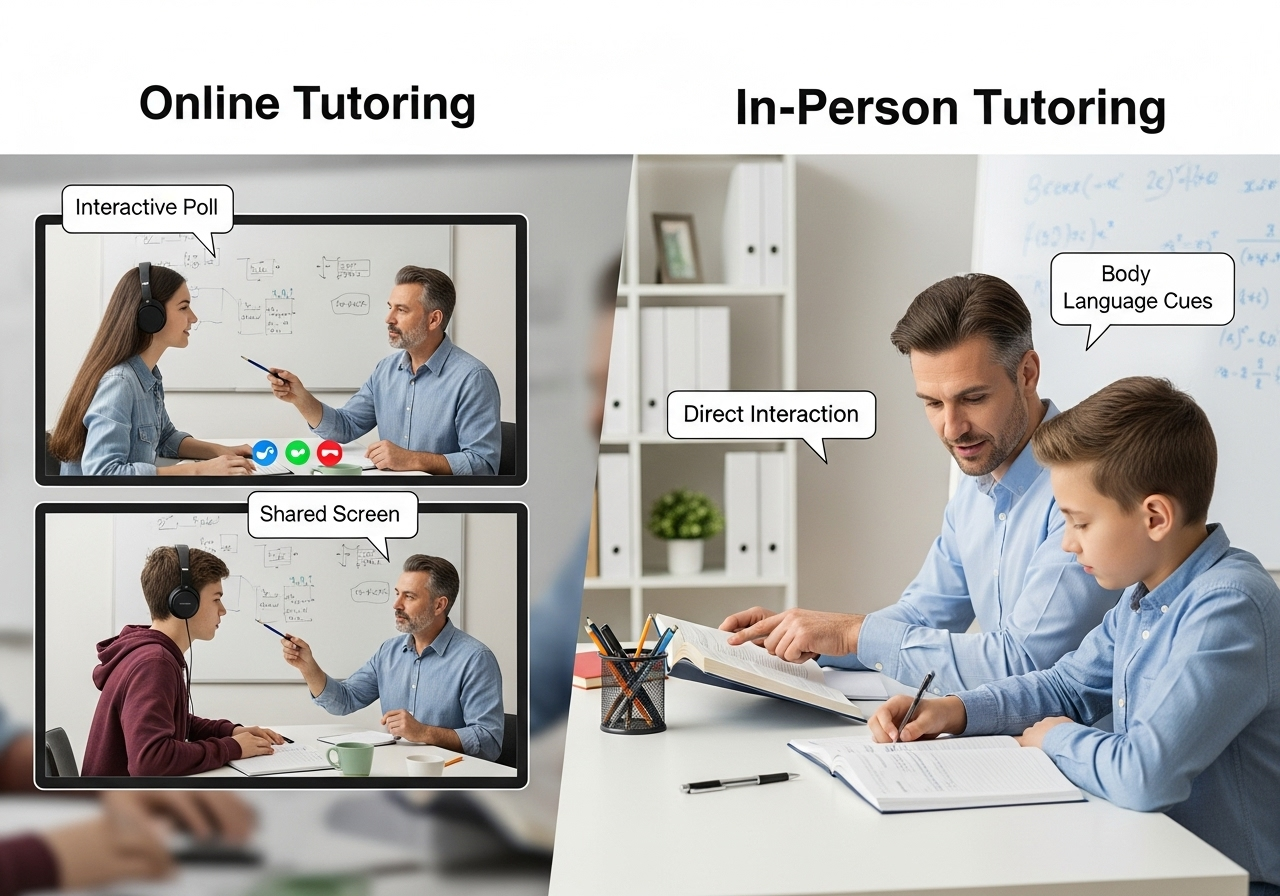
Tutoring has been helping students over the years to perform better academically. While the old methods of in-person tutoring still prevail, new and efficient online tutoring methods are also gaining traction, thanks to the growth witnessed in the global tutoring market. In fact, as per a report by Economics of Education Review, online tutoring showed about a 7.57% increase in math scores.
Even though since 2000 online learning has grown more than 900%, there are still students who prefer in-person learning for a variety of benefits. As a tutor, you must want to provide the best learning experience for your students. So it is natural to wonder how do you tutor someone, whether it is online or in person.
So let us dive into the actual difference between online tutoring vs. in-person tutoring and their advantages and finally understand which method will be the best for you.
How Do You Tutor Someone Online?
Many people believe tutoring online is just about explaining concepts on a Zoom call, but it is far more than that. Online tutoring is a structured and technology-driven approach to help students learn without needing to attend a class physically.
If you prefer the online tutoring method, then here is how you can do it:
1. Setting the Environment
For a tutoring session to happen seamlessly, both the tutor and the students must ensure that they do not have distractions and that they are present in a well-lit space with a good internet connection. Other requirements include headphones, a webcam, and a quiet background.
2. The Right Platform
It is necessary to select an online platform that can help you conduct classes. The choice will majorly depend on your requirements. Some options include:
- General Tools: Zoom, Google Meet, Microsoft Teams
- Tutor Management Software: Wise, Tutor Cruncher, Preply
Pro-tip: Opt for tutor scheduling software so that you can handle the operational part of tutoring seamlessly while conducting classes.
3. Understand Students’ Needs
To make sure your students excel, it is necessary to understand their needs. You can ask questions or even conduct a short test to gauge the needs. It will help to assess:
- The student’s current level.
- Their strengths and weaknesses.
- Learning goals (exam prep, skill-building, homework help).
4. Crafting Lessons
Tutors can prepare digital lesson plans that have a balance of explanation, practice, and feedback. Crafting a structured lesson plan will prevent sessions from being unorganized and also help in measuring progress.
5. Keep It Interesting
One of the biggest online tutoring advantages is engagement via technology. Here are some things you can try to keep your students engaged:
- Use digital whiteboards for diagrams or solving equations.
- Conduct polls and quizzes mid-session.
- Share videos, simulations, or animations.
6. Track Progress
Some tutor management software allows you to track students’ progress and also give them real-time feedback via dashboards. Here is what you can do:
- Assign online homework with instant grading.
- Share feedback through Google Docs or learning apps.
- Send reports to parents (for school-age students).
7. Build Rapport
Online tutoring can feel cold or even distant; hence, tutors must overcome this obstacle by:
- Starting sessions with casual check-ins.
- Encouraging students to share struggles openly.
- Use humor.
- Use relatable examples.
8. Be Open To New Styles
Not all students will learn in the same way, and hence, tutors must adapt to new teaching styles and tools:
- Slides and infographics for visual learners.
- Recorded explanations, discussions, and podcasts for auditory learners
- You can also use interactive simulations or typing exercises for kinesthetic learners.
9. Online Assessments
Integrating online tests and quizzes is great for evaluating performance. Using Google Forms or Kahoot can help provide instant results. A quick assessment helps tutors to make changes in their lesson plan as per the results.
10. Keep Student Engaged
Make sure that the students continue learning even after the class ends. You can try:
- Chat groups for quick Q&A.
- Assignments with deadlines.
- Shared resource libraries.
How Do You Tutor Someone In Person?
In-person Tutoring is the traditional form of tutoring where student and tutor meet physically, either in a classroom, at the student’s home, at a library, or even at a tutoring center. This process relies on direct interaction, body language, and hands-on learning.
Here is how you can tutor someone in person:
1. Set Up a Learning Space
Selecting an appropriate and positive environment is essential. Make sure to have:
- A quiet room with a desk or a table.
- Proper lighting
- Minimal distractions.
- Study material
- Practice tests.
This will help students to stay focused and learn more.
2. Establish Rapport
Since you will be face-to-face with the students, you can establish a personal connection rather easily. You can begin with a friendly chat by asking about the student’s school life or even hobbies.
3. Assessing Student Needs
In-person tutoring allows tutors to review school assignments, school notes, and conduct a short oral quiz to understand where the student needs help. Alternatively, you can also ask the students what they are looking for.
4. Lesson Planning
In-person lesson plans can be similar to online tutoring, but there is more flexibility and room for real-time adjustments. As you are physically present, you can easily adjust the pace as per the student’s body language and expressions.
5. Leveraging Non-Verbal Cues
Unlike the online sessions, in-person tutoring allows tutors to spot confusion, distraction, or even lack of confidence in an instant. Here are some cues to look out for:
- Fidgeting = loss of focus.
- Blank stares = confusion.
- Smiles or nods = understanding.
- Looking here and there = being distracted.
6. Hands-on Learning
In-person tutoring is a good method for subjects where physical demonstration becomes more fruitful:
- Science: Simple experiments with lab materials.
- Math: Writing and solving equations together on paper.
- Arts/Music: Demonstrations that can’t be replicated virtually.
7. Maintaining Focus
In-person Tutoring offers a great opportunity to keep the students focused without procrastination. Tutors can redirect attention whenever necessary. This is especially helpful for younger students.
8. Personalised Feedback
Review of written work and corrections can be done instantly in in-person training. Moreover, tutors can instantly notice if the students hesitate before answering a question. It allows personalized and real-time feedback.
9. Encouragement and Motivation
In in-person tutoring, the tutor and student are face-to-face, which can help the tutor boost the student’s confidence with high-fives or other encouraging body language. You can motivate your students to stay consistent and put effort in by encouraging them
10. Learning Beyond Session
Tutors can assign practice work, homework, and assignments. It could be test papers, worksheets, or even books. It will keep the students immersed in learning beyond the sessions.
Online Tutoring Vs In-Person Tutoring: Comparison At A Glance
|
Factor |
Online Tutoring |
In-Person Tutoring |
|
Flexibility |
Learn from anywhere, anytime |
Limited by geography & scheduling |
|
Tutor Options |
Global pool of experts |
Restricted to local availability |
|
Engagement |
Relies on digital tools; distractions possible |
Strong eye contact, body language, and personal connection |
|
Cost |
Often more affordable due to no travel |
May be costlier (travel, time commitment) |
|
Learning Style Fit |
Great for tech-savvy, independent learners |
Best for younger students or hands-on subjects |
|
Resources |
Interactive tools, recordings, online materials |
Physical books, notes, and one-to-one demonstrations |
Which Tutoring Method Works Best?
Well, the answer to this question is dependent on the learner’s needs.
Opt for online tutoring if:
- You want flexibility in scheduling and location.
- Students are tech-savvy, self-motivated, and comfortable with digital tools.
- The subject needs screen-based explanations (e.g., math, coding, languages).
- You want a wider audience beyond your local area.
Opt for in-person tutoring if:
- The student needs close supervision, structure, and discipline.
- Subjects require hands-on learning (e.g., science experiments, handwriting, music).
- Younger learners or those easily distracted.
- If you need to build confidence.
Opt for hybrid tutoring if:
- You want to combine flexibility with personal connection.
- Theory can be taught online, but practical or feedback-heavy sessions are done face-to-face.
- Both tutor and student value a balance between convenience and depth of interaction.
Conclusion
As a tutor, deciding between online tutoring and in-person tutoring depends on the students as well as your needs. There are online tutoring advantages and also in-person tutoring benefits. One approach that can provide the best of both worlds is the hybrid approach. In the end, it is all about high-quality tutoring irrespective of the tutoring method.
FAQs
How do you tutor someone online effectively?
By using video calls, digital whiteboards, screen sharing, interactive quizzes, and personalized lesson plans.
How do you tutor someone in person effectively?
By creating a distraction-free space, using hands-on examples, reading body language, and offering instant feedback.
Is online tutoring as effective as in-person tutoring?
Yes, studies show online tutoring can match in-person results when sessions are interactive and structured.
Can you combine online and in-person tutoring?
Yes, a hybrid approach often works best, using online for flexibility and in-person for deeper learning.