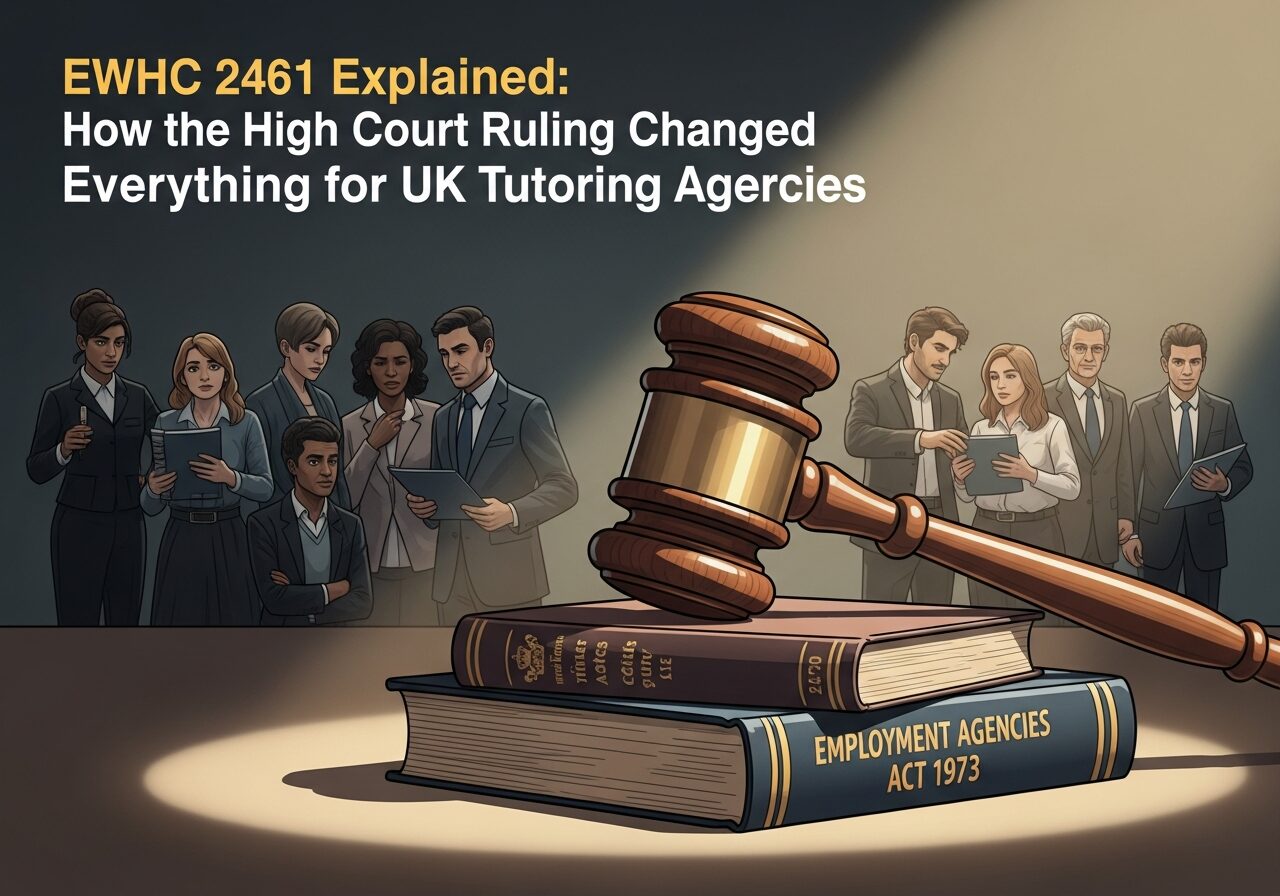
The UK tutoring industry was reshaped in 2020, post the landmark High Court case known as the Simply Learning Tutor Agency Case. The judgment on Simply Learning Tutor Agency Ltd & Others v Secretary of State for Business, Energy and Industrial Strategy (EWHC 2461) has definitely had a profound impact.
Earlier, several tutoring agencies in the UK primarily operated in a grey area, where they handled client payments, distributed tutor fees, and referred to the tutors as “self-employed”. It continued until the High Court clarified that such agencies are, in fact, employment agencies under UK law.
The legal clarification has significantly impacted how tutoring agencies manage finances, taxes, and compliance today. In this article, we will explain what EWHC 2461 means, the decision as per the Employment Agencies Act 1973, how the High Court ruling for tutoring businesses transformed the landscape, and why tutoring agency compliance in 2025 is now non-optional.
The Background: A Growing Industry in Legal Grey Area
Tutoring in the UK has become one of the most popular career choices. Between 2015 and 2020, the UK’s private tuition market grew by nearly 40%, with agencies and online platforms springing up across the country.
Among these tutoring agencies, several follow a simple formula:
- A parent pays the tutoring agency for sessions.
- The agency takes its commission.
- The rest goes to the tutor.
This model did not garner much attention until the news surfaced that it conflicted with the Employment Agencies Act 1973. This law is in place to protect workers and ensure agencies operate fairly.
What Made It Complicated?
The Employment Agencies Act, 1973, states that an “employment agency” cannot control or withhold payments intended for the worker. However, this technicality has been ignored on the basis that it only applies to recruitment firms.
But when several agencies, led by Simply Learning Tutor Agency Ltd, challenged the government’s interpretation, the High Court was forced to answer: Does a tutoring agency introducing self-employed tutors count as an employment agency under UK law?
The 2020 Case: Simply Learning Tutor Agency Ltd v BEIS (EWHC 2461)
The Simply Learning Tutor Agency case, EWHC 2461, was heard before the High Court in September 2020. The claimant agencies argued that they were not employment agencies, since tutors worked independently and clients paid the agency primarily for “matching” services.
The government was represented by the Department for Business, Energy and Industrial Strategy. The argument was that the agencies were indeed employment agencies, as they introduced individuals to provide work for clients and handled the payments.
For anyone planning to start or wishing to expand their tutoring business, understanding this distinction is now crucial to staying on the right side of the law.
What Did the Court Rule?
Justice Cavanagh delivered a decisive judgment. He ruled that:
- Agencies that introduce tutors for paid work fall within the definition of “employment agency” under the Employment Agencies Act 1973.
- The Conduct of Employment Agencies and Employment Businesses Regulations 2003 apply in full.
- EWHC tutoring agencies cannot handle money owed to tutors, even temporarily.
It implied that the payment for the tutoring sessions belonged to the tutor, not the agency. In short, the agency is only entitled to the commission, not to control or retain the remaining funds.
How Did the Ruling Change Things?
The ruling has been successful in redrawing the operational boundaries for the entire tutoring industry. Before EWHC 2461, or the Simply Learning Tutor Agency case, most agencies functioned as intermediaries handling client payments. After the ruling, that model became legally untenable.
The Employment Agency Standards Inspectorate (EAS), which is the responsible body for enforcing such law, now expects all tutoring agencies to comply with the following:
- Tutors must be paid directly by the client or via a compliant split payment system.
- Agencies cannot hold, deduct, or redistribute tutor funds.
- Agencies may only invoice for their commission, not the tutor’s pay.
- Tutors cannot be charged any fees for registration or finding work.
In fact, modern tutoring software platforms now integrate these payment models, enabling agencies to automate compliance seamlessly.
The Solution: Split Payment
So how can agencies ensure compliance without hampering the smooth experience for tutors and clients? The answer is split payments.
Split payment is a financial mechanism that allows one payment from the client to be automatically divided between the tutor and the agency.
Here:
- A client makes a single payment online.
- The payment processor instantly splits it, sending the tutor’s portion to their account and the commission to the agency.
- The agency never touches or holds the tutor’s money.
This aligns with the High Court ruling as well as the EAS guidelines, as the agencies can no longer control the funds owed to the tutor.
Modern platforms like Stripe Connect, Wise, and GoCardless have made split payments automated and traceable. This way, agencies can remain compliant without needing to reinvent their systems.
The Revenue Threshold Myth
A common misconception after the EWHC 2461 ruling is that small agencies don’t need to worry about compliance until they reach an inevitable turnover, often linked to the £90,000 VAT registration threshold.
The reality is that, regardless of revenue or agency size, there is no exemption. Whether your tutoring agency has five tutors or five hundred, if you introduce tutors to clients and handle payments, you fall under the act’s definition of an employment agency.
For new founders planning to start their tutoring business, this means compliance applies from day one, not after reaching a certain revenue level. Whether you serve ten families or a thousand, you must align with the ruling.
The Two Legal Models Post-Ruling
After the ruling under EWHC 2461. There are two legal models that a tutoring business can follow:
Employment Agency Model
Under this model:
- You introduce self-employed tutors to clients.
- Tutors invoice clients or are paid directly (via split payments).
- You only invoice for your commission.
- VAT applies only to the commission (if applicable).
Employment Business Model
Under this model:
- You employ tutors directly or subcontract them under your control.
- You invoice the full amount to the client, then pay tutors as employees or contractors.
- VAT applies to the full invoice.
- You manage PAYE, pensions, holidays, and employment law obligations.
Timeline: From Grey Zone to Legal Clarity
The EWHC 2461 tutoring agencies ruling transformed a grey zone into clear legal ground for the UK tutoring business. Here is the timeline:
|
Year |
Event |
Impact |
|
Pre-2020 |
Agencies collect client payments and distribute tutor pay |
Widespread non-compliance (grey area) |
|
2020 |
High Court ruling (EWHC 2461) |
Defines tutoring agencies as “employment agencies” |
|
2021–2023 |
EAS starts active enforcement |
Agencies warned, some fined |
|
2024–2025 |
Split payment systems become industry standard |
Automated compliance tools integrated even in tutor management/tutor scheduling softwares |
|
2025 onwards |
Ongoing regulation |
Transparent payment structures expected |
What Are the Consequences of Non-Compliance?
The Employment Agency Standards Inspectorate has the authority to investigate, fine, or even shut down non-compliant tutoring agencies.
Here are the results of non-compliance:
- Unlimited fines for serious breaches.
- Director disqualification orders under the Company Directors Disqualification Act 1986.
- License suspension or revocation.
- Criminal prosecution in cases of fraud or systemic non-compliance.
Even holding funds for administrative reasons or batching payments can also be considered a breach of the rules.
Case Studies
Case 1: The one-invoice agency
The agency sent a single invoice for client payment, covering both the tutor’s fee and the agency’s commission.
Concern: The agency controlled the full payment and then paid the tutor later, which constitutes a breach under the Employment Agencies Act 1973 in relation to the tutoring model.
Fix: The agency switched to dual invoices, where the tutor receives a fee directly and the agency receives the commission separately.
Case 2: The registration fee agency
A London-based tutoring company charges an onboarding fee.
Concern: Under the Conduct Regulations (2003) that implement the Employment Agencies Act 1973, agencies cannot charge workers for introducing them to work.
Fix: The agency ultimately removed the fee. They shifted to earning commission online from the sessions.
These case studies demonstrate that compliance is now mandatory and can be relatively simple once the right systems are in place.
Conclusion
One of the most impactful events for UK tutoring agencies happened with the Simply Learning Tutor Agency case (EWHC 2461). The decision forced agencies to examine closely how they introduce tutors, structure payments, and invoice clients. Now, tutoring agency compliance in 2025 is no longer optional; it is now a foundational requirement. Agencies that adopt compliant models built around split payments, clear documentation, and transparent contracts will not only avoid regulatory risk but also develop stronger relationships with tutors and clients.
Frequently Asked Questions
What is the EWHC 2461 ruling for tutoring agencies?
It’s a 2020 decision by the High Court in the Simply Learning Tutor Agency case, which confirmed that tutoring agencies that introduce self-employed tutors to clients fall under the Employment Agencies Act 1973.
Do I need to use split payments?
While the legislation does not explicitly say “split payments”, the ruling and regulator guidance strongly point to it as the only practical way to comply for tutoring agencies operating under the Employment Agency Model.
Can I charge tutors a registration or platform fee?
No. Under the Conduct of Employment Agencies and Employment Businesses Regulations (2003), which implement the Employment Agencies Act 1973, you cannot charge tutors for finding them work.
What records must I keep for compliance in 2025?
Contracts with tutors and clients, DBS and safeguarding checks (if applicable), payment logs, split payment proof, invoicing and VAT records, and monthly reconciliations.