
It is a no-brainer that tutoring is one of the most thriving career options due to the high demand. If you are thinking of starting a tutoring agency in the UK, one important structural decision that you have to make is which regulatory model you must operate under.
This choice isn’t just legal semantics; it shapes how you pay tutors, your VAT obligations, your admin costs, and even how scalable your tutoring operations can be when you expand your tutoring business. So, you can choose to operate as an employment agency or an employment business.
Today, we will break down everything you need to know about these two models, as well as other essential concepts, such as compliance costs and cost calculators, to help you determine which model is best for you.
So let us begin!
Two Compliant Models: Employment Agency vs. Employment Business for Tutoring Business
For any tutoring agency in the UK, it is mandatory to operate under either of the two models outlined in the Conduct of Employment Agencies and Employment Businesses Regulations 2003 and the Employment Agencies Act 1973.
Each model will have its own cost implications, VAT treatments, and operational burdens. Both models are explained below:
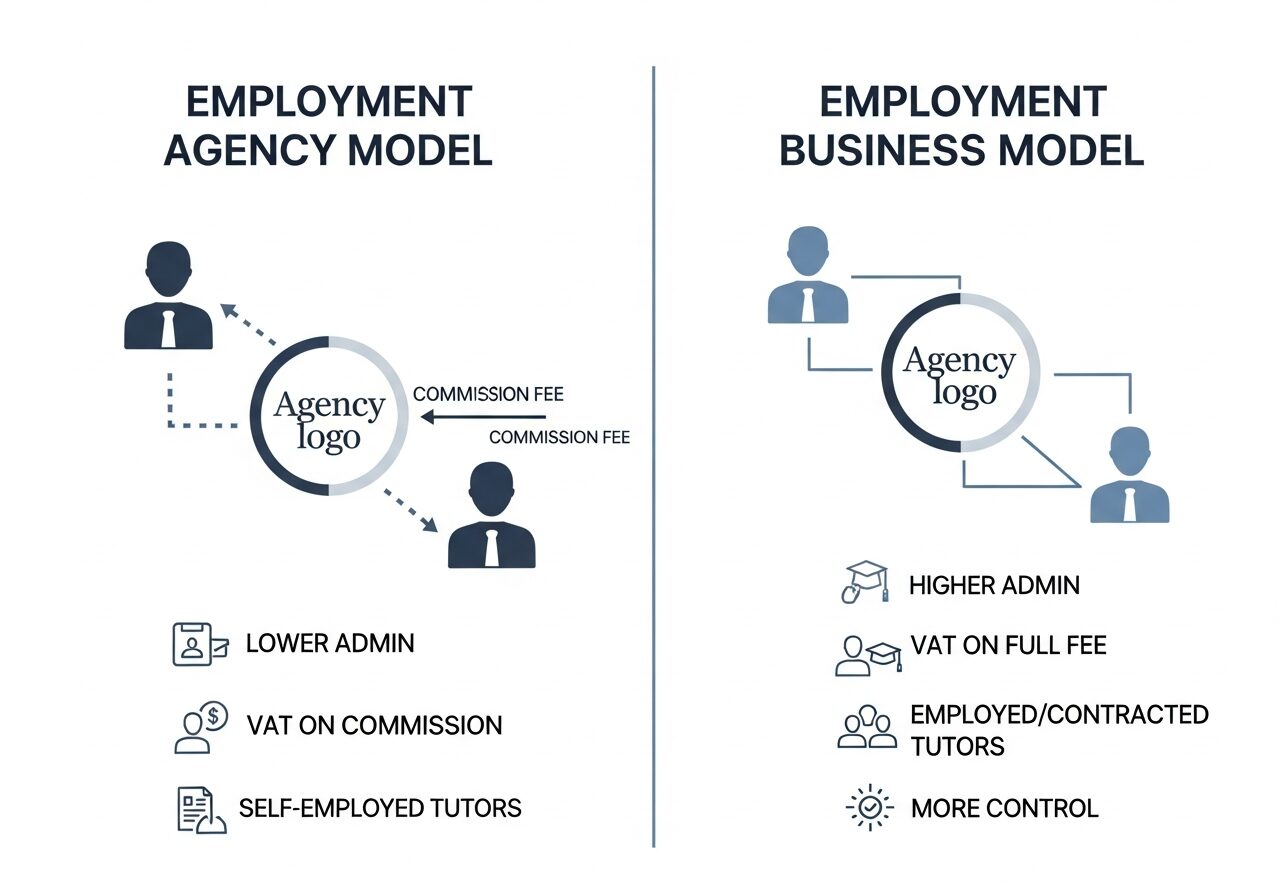
1. Employment Agency Model
This model will apply to your tutoring agency in the following case:
- You introduce self-employed tutors to clients, who then pay the tutors directly.
- The agency’s revenue comes from commissions or introduction fees.
- You do not control the payment timing or the pay rate of the tutor.
- You can avoid the full employment burdens, as you are supplying staff.
- For VAT purposes, you may only charge VAT on your commission (not on the full tutor fee) in certain circumstances.
- It is best when the agency’s only roles are matching or introducing, rather than managing.
- Less control over tutor quality, scheduling, or supervision.
The UK guidance describes employment agencies and employment businesses as follows: “If your business introduces workers to clients,” this is more likely to be an agency.
2. Employment Business Model
It is applicable when the agency supplies tutors under its own contract. So, you either employ the tutors (or engage them as subcontractors under your control). Key features of this model include:
- Your agency invoices the client for the full fee (tutor fee + agency margin).
- The payment to the tutor is made from the collected fees.
- You control pay rates, schedules, supervision, and service delivery.
- Full employment law obligations may apply (e.g., PAYE, pensions, holidays, etc.).
- Since you are supplying the services of the staff, you can charge VAT on the full invoice. HMRC confirms that “a bureau when acting as an employment business is making a supply of staff, which is taxable.”
- The administrative cost can be on the higher side, along with an increased regulatory burden. However, the control and margin capture are stronger.
A Quick Comparison Explaining Employment Business vs. Employment Agency
Let us quickly compare the models to understand the concepts of employment business vs. employment agency. It will help to understand the compliance and operational impact before choosing the right model:
|
Aspect |
Employment Agency Model |
Employment Business Model |
|
Tutor employment status |
Self-employed tutors contract with the client |
Tutor employed or contracted by the agency |
|
Who pays the tutor? |
The client pays tutor directly |
The agency pays the tutor from the collected fees |
|
Who controls tutor pay/schedule? |
The tutor/client sets the rate and schedule |
Agency sets rate, controls schedule |
|
Revenue model |
Commission/introducer fee by agency |
Full invoice from agency (tutor fee + margin) |
|
VAT treatment |
Possibly VAT only on commission (depending on subject qualification) |
VAT on full supply of staff/services |
|
Admin & compliance burden |
Lower (fewer employment obligations) |
Higher (employment law, PAYE, pensions, etc.) |
|
Control over teaching quality |
Limited |
Much greater |
|
Best for |
Lower overhead, lighter touch model |
Higher control, larger scale, premium service |
Detailed Cost Comparison: Real-World Tutoring Scenarios
To better understand the distinction between the employment business vs. the employment agency concept, consider the following real-world cost examples. It helps to understand how each model performs financially:
Scenario A – Maths Tutor (Qualifying Subject)
|
Aspects |
Employment Agency |
Employment Business |
|
Client pays |
£50/hr |
£50/hr |
|
Agency commission |
20% (£10) |
20% (£10) |
|
Tutor fee |
£40/hr |
£40/hr |
|
VAT |
On £10 only = £2 |
On £50 = £10 |
|
Total cost to client |
£52 |
£60 |
|
Net profit to the agency |
£10 – minimal admin |
£10 – after payroll costs |
Scenario B – Science Tutor (Qualifying Subject, employed)
|
Aspects |
Employment Agency |
Employment Business |
|
Client pays |
£55/hr |
£55/hr |
|
VAT |
£2 on commission |
£11 in total |
|
Admin/Payroll |
Minimal |
£3–5/hr (PAYE + pensions) |
|
Total cost |
~£57 |
~£65–£68 |
Scenario C – Non-Qualifying Subject (e.g., Music, Languages)
VAT is applicable in both models for non-qualifying subjects.
- Employment Agency: VAT on commission (still cheaper).
- Employment Business: VAT on full invoice + payroll.
Hidden Costs Agencies Often Miss
There are certain hidden costs that even tutoring agencies often underestimate. Let us look at such costs:
PAYE and Pensions: Under the employment business model, this accounts for approximately 13–15% of total costs.
Holiday Pay and Sick Leave: It is a legal requirement for employed tutors.
Insurance & Legal Compliance: Extra costs for handling payroll and employment contracts.
Software Integration: If you manage multiple tutors, investing in tutor management software or tutor scheduling software is essential for automating tasks and tracking compliance.
VAT Reclamation Complexity: Especially when dealing with both qualifying and non-qualifying subjects.
How to Know Which Model Is the Best for Your Tutoring Agency?
When deciding between an employment business and an employment agency, several key aspects must be considered.
|
Stage |
Best Model |
Reason |
|
Starting your tutoring business |
Employment Agency |
Lower costs, flexible, VAT advantage |
|
Expanding your tutoring business |
Employment Business |
Complete control, consistent branding |
|
Multi-subject tutoring |
Hybrid approach |
Combine both, depending on the subjects |
|
High client volume |
Employment Business + tutor management software |
Scalable automation |
Interactive Cost Calculator (Free Download)
For a more straightforward decision-making process, here is a cost calculator that can help you compare:
- Payroll vs non-payroll costs
- VAT impact
- Profit margins under both models
- Tutor pay breakdowns
Download the calculator here.
Case Studies
Case Study No. 1
A tutoring firm started as an employment agency for STEM subjects. A few years down the line, they switched to the Employment Business to gain more control over pricing as well as tutor quality.
Result: Costs rose 12%, but revenue increased 40% due to consistent client experience.
Tools Used: Implemented tutor management software to automate payroll and timetables.
Case Study No. 2
A language tutoring startup implemented a hybrid model, setting up an agency for self-employed language tutors and a business model for in-house English tutors.
Result: Saved ~18% in VAT overall.
Tools Used: Tutor scheduling software for flexible sessions, cutting admin time by 30%.
Conclusion
When deciding between an employment agency vs an employment business model, the choice ultimately depends on your requirements, resources, and growth plans. If you’re looking to start your tutoring business with minimal admin and lower costs, the employment agency model offers flexibility and simplicity. However, if you want to gain more control over tutor quality or ensure that your brand value is substantial, then the employment business model is the best option.
Frequently Asked Questions
What’s the main difference between an employment agency and an employment business for tutoring?
An employment agency introduces self-employed tutors to clients, while an employment business employs or subcontracts tutors directly and manages their pay, schedule, and compliance.
Can a tutoring business operate as both an Employment Agency and an Employment Business?
Yes. A company can legally operate as both an Employment Agency (EA) and an Employment Business (EB) at the same time. This is commonly known as a hybrid employment model.
Under this structure, a single organisation may:
- Act as an Employment Agency for certain services, where it introduces workers to clients and the contract is between the worker and the client.
- Act as an Employment Business for other services, where the company supplies and pays workers directly to deliver services.
This is permitted under UK regulations, provided the business follows the correct legal and contractual requirements for each model.
Can different services within the same business be treated as Employment Agency and Employment Business work?
Yes. Different services or offerings within the same organisation can be classified separately as either Employment Agency (EA) or Employment Business (EB) activities.
Some services may be delivered under an EA model, while others are delivered under an EB model. The key requirements are that:
- The correct contracts are used for each type of service
- Workers and clients clearly understand which model applies
- The business complies with the relevant regulatory and VAT obligations for each model
This flexibility allows businesses to structure services in the most appropriate way without needing separate legal entities.
Which is more cost-effective: an employment agency or an employment business?
The Employment Agency model is typically more cost-effective, as VAT is only applied to the commission and not the total invoice, unlike the Employment Business model, where VAT is applied to the full amount.
Can I switch from an employment agency to an employment business model later?
Yes, many tutoring firms start as employment agencies and transition to an employment business model as they expand their tutoring business and need greater control over tutors.
Does the employment agency model offer more flexibility for tutors?
Yes, tutors under the Employment Agency model are self-employed, allowing them the freedom to set their own rates and schedules and work with multiple clients.