Whether you are an independent tutor or an employment agency model with about 20 staff members and multiple bookings per week, one question that is often confusing is VAT (Value Added Tax).
One key issue is whether your services are exempt from VAT. Get it wrong, and you risk big surprises in your tax bill (plus penalties). Many agencies and independent tutors unknowingly overcharge or undercharge clients simply because they’re unsure about VAT exemption rules.
Today, we are going to explain VAT exemption for tutors, which subjects qualify, how to classify them correctly, how much you can save, and what court rulings imply.
Understanding VAT Exemption for Tutors
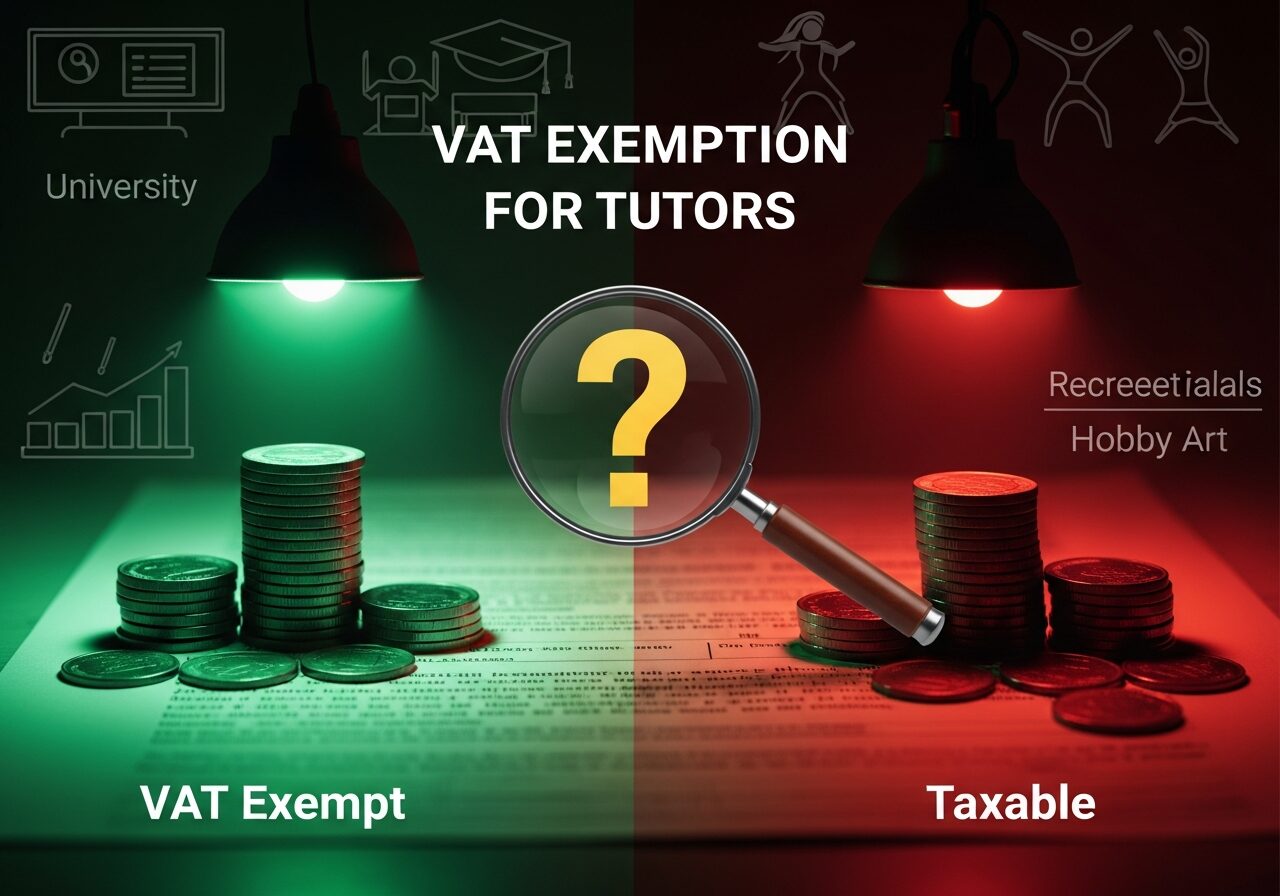
In the UK, private tutoring is typically exempt from VAT, provided it meets specific conditions. HMRC’s rules state that tuition is exempt from VAT when it is delivered privately by an individual teacher and relates to a subject ordinarily taught in schools or universities.
Here are the things a tutor must remember when it comes to qualifying for VAT exemption for tutors:
- Either the tutor must be self-employed or directly employed by the student.
- The subject taught must be “ordinarily taught in schools or higher education.”
- The lessons must be for educational purposes, not for hobbies or recreation.
Which Tutoring Subjects Are VAT-Exempt in the UK?
The important fact is that not every subject will qualify for VAT. The key lies in whether it’s considered “ordinarily taught in schools or universities.”
Let us look at which tutoring subjects are VAT-exempt in the UK:
|
VAT-Exempt Tutoring Subjects (UK) |
Taxable Tutoring Subjects |
|
English, Maths, Science |
Dance classes (Ceroc, Salsa, Zumba) |
|
History, Geography, Politics |
Music production, DJ lessons |
|
Modern languages (French, Spanish) |
Art for leisure (e.g., painting for fun) |
|
Computer Science, Coding (if GCSE/A-level syllabus) |
Coding for a hobby or game development |
|
Business Studies, Economics |
Fitness training, Yoga |
|
Religious Education, Philosophy |
Personal development coaching |
|
Exam preparation (GCSE, A-Level, 11+) |
Life skills, self-help tutoring |
Why “Ordinarily Taught in Schools” Matters?
To determine the VAT exemption for tutors, the phrase “ordinary taught in schools” is quite essential. If the subject is recognized within the UK National Curriculum or university framework, it is qualified. For example:
- French tuition → Exempt (taught in schools)
- Ceroc dance lessons → Taxable (not part of standard education)
How VAT Affects Pricing: Real Cost Impact?
VAT often seems like a minor detail; however, it has a significant impact on the pricing and profitability of your tutoring business. Whether your lessons are VAT-exempt or taxable directly affects how much students pay and how competitive your employment agency model appears in the market.
Here is how VAT changes the real cost of a tutoring package:
|
Aspects |
Without VAT Exemption |
With VAT Exemption |
|
Tuition package (10 lessons @ £100) |
£1,000 + £200 VAT = £1,200 total |
£1,000 (no VAT) |
|
Client pays |
£1,200 |
£1,000 |
|
Agency revenue (if VAT-registered) |
Must remit £200 to HMRC |
Keeps full £1,000 |
The results:
- When the correct VAT exemption for tutors rules are applied, your tutoring business instantly becomes 16.6% more competitive in terms of price.
- For agencies, understanding and classifying subjects accurately can mean the difference between profitable pricing and avoidable VAT liabilities.
How to Classify Your Tutoring Subjects Correctly?
To determine if your services qualify under VAT exemptions for tutors, it is necessary to classify your tutoring subjects. A single misclassification can lead to overcharging clients or facing HMRC penalties later.
Here are the things that you must check to help you get the classification right:
- Is it on the National Curriculum or part of a recognised qualification (GCSE, A-level, IB, university course)?
- Is the tutor teaching in their personal capacity or as an employee of a VAT-registered employment agency model?
- Is it academic, exam-related, or purely recreational?
- Document lesson plans, syllabi, and qualifications to prove your exemption status in case of an HMRC audit.
Pro-tip: Track subjects, tutor profiles, and lesson classifications with tutor management software to make compliance easier.
Common VAT Mistakes Tutoring Agencies Make
Mistakes are bound to happen, regardless of whether you are an experienced tutor or a business. Let us look at the most common mistakes that are to be avoided:
- Charging VAT when it isn’t necessary. You will ultimately lose clients due to inflated pricing.
- Failing to charge VAT when required, thus leading to HMRC penalties later.
- Misclassifying leisure subjects as educational.
- Assuming employment agency model-delivered lessons are automatically exempt.
- Not maintaining clear records of who delivered the tuition.
To ensure that your invoices reflect proper VAT treatment, you can use a reliable tutor scheduling software to track sessions and tutors.
How VAT Exemption Affects Your Business Strategy?
VAT exemption for tutors is not simply a tax detail; it is, in reality, a strategic advantage that many tutoring businesses miss.
- For start-ups, lower initial pricing helps attract students and compete with larger agencies.
- For established agencies: Correct VAT handling can improve your margins and compliance.
- For parents: VAT exemption keeps learning more affordable.
It is essential to understand how VAT rules affect your business, especially if you are considering starting or expanding your tutoring business.
Recent Tribunal Decisions and What They Mean
HMRC tribunal decisions play a significant role in shaping the application of VAT rules. Recent cases have clarified what counts as an educational service versus a recreational one, and who is responsible for charging VAT.
Here are the latest rulings that tutors and agencies must be aware of:
- Rushby Dance Case (2019): Not exempt because the subject wasn’t taught in schools.
- Ceroc Dance Case: Confirmed that dance fitness classes were for recreation, not education.
- Simply Learning Tutors (EWHC 2461, 2024): Set precedent for agencies under the Employment Agencies Act 1973, clarifying who supplies the service (tutor vs employment agency model) and who is responsible for VAT.
How Can Technology Help to Stay VAT-Compliant?
It can be quite challenging for a tutoring business to stay VAT compliant. However, technology can make it easier. With tools like tutoring management software and tutor scheduling software, you can automate record-keeping, track taxable and exempt lessons, and generate accurate invoices so that compliance is not a problem.
Tutoring agencies can:
- Track taxable vs exempt lessons automatically
- Generate HMRC-compliant invoices
- Maintain accurate tutor profiles
- Manage split payments and commissions seamlessly
Conclusion
To build a smarter and more competitive tutoring business, it is essential to understand VAT exemption and its associated compliance requirements. By classifying subjects correctly, using reliable tutoring software to manage records, and staying updated on HMRC rulings, you can avoid costly mistakes and keep your pricing attractive. It can help improve margins as well as competitiveness. So, it is not just about tax but about smart positioning and pricing.
If you’re planning to start your tutoring business, take VAT classification seriously from day one; it could be the easiest way to save thousands and stand out in a crowded market.
Frequently Asked Questions
What is VAT exemption for tutors in the UK?
VAT exemption for tutors means that certain private tuition services are exempt from VAT, provided the lessons are academic and are “ordinarily taught in schools or universities.”
Do tutoring agencies qualify for VAT exemption?
Tutoring agencies usually cannot claim full VAT exemption because they act as intermediaries. However, individual tutors teaching directly to students may qualify.
How does HMRC decide which subjects are VAT exempt?
HMRC considers whether the subject is “ordinarily taught” in schools or universities and whether it serves an academic or educational purpose rather than recreation.
Can a tutoring employment agency model split VAT between the tutor and the employment agency model fee?
Yes. Some agencies use split payment systems or tutoring management software to apply VAT only to their commission, while keeping the tutor’s fee exempt from VAT.