
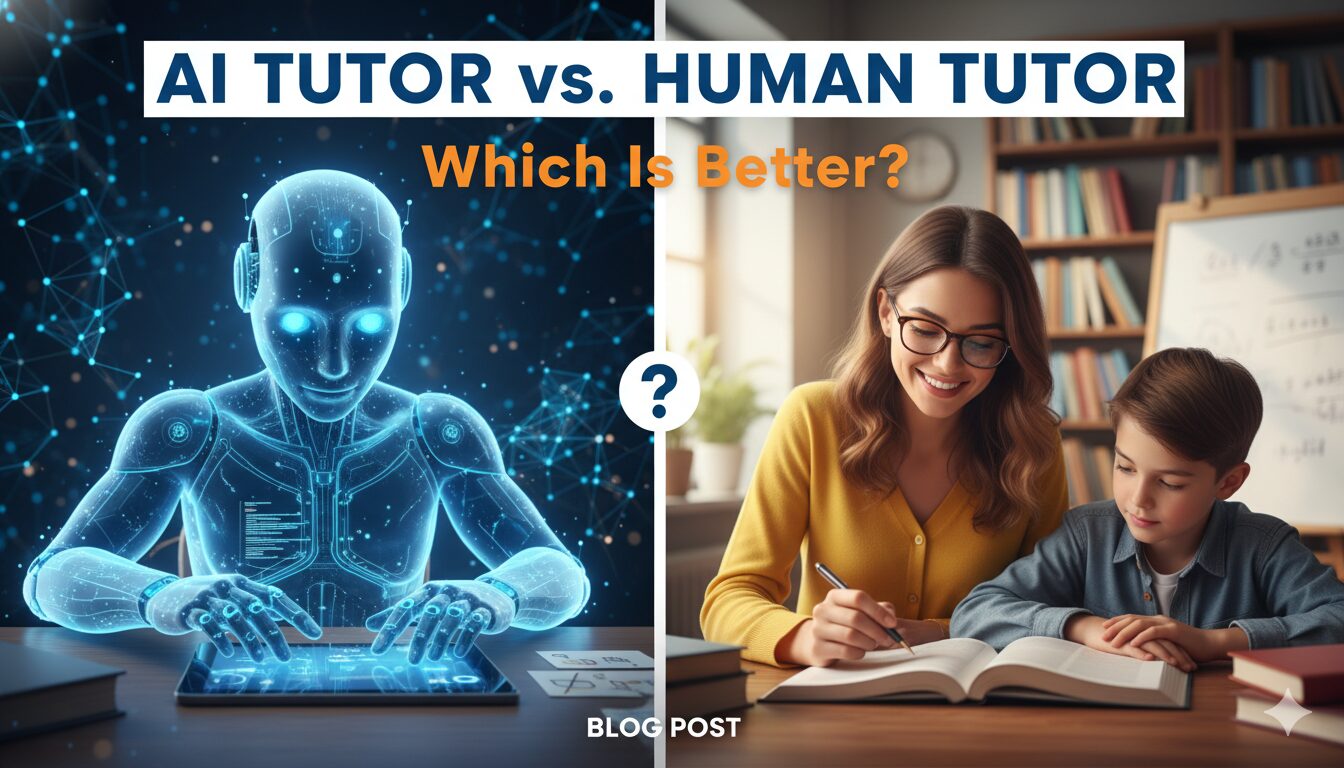
Tutoring is changing faster than ever. Students now have access to intelligent software, adaptive platforms, and live one-on-one mentoring from anywhere in the world. Naturally, one question arises: AI Tutor vs. Human Tutor: Which is Better?
AI has evolved from simple chatbots into sophisticated adaptive learning systems. One of the most significant advantages of AI learning bots vs. human tutors is availability. A human tutor has a schedule, a commute, and a need for sleep. AI, on the other hand, is available at 2:00 AM when a student is stuck on a calculus problem.
This 24/7 accessibility is a major factor in the AI tutors vs. human tutors effectiveness comparison, especially for busy high school students balancing extracurriculars and academics. However, there are many other factors to consider when declaring a winner.
This article outlines everything students and parents need to know, including a detailed comparison of AI tutors versus human tutors.
Understanding the Basics: What Is an AI Tutor?
An AI tutor is a software-based learning system that utilises AI, machine learning, and data analytics to personalize lesson plans and sessions. Platforms such as Khan Academy, Duolingo, and Carnegie Learning integrate AI features to adapt content based on student performance. Other platforms like Wise use AI-powered technologies to make tutoring much easier.
Here are some of the benefits of AI tutors:
- It can analyze mistakes in real time
- It can adjust the difficulty automatically
- Give instant feedback
- Offer 24/7 accessibility
The Irreplaceable Human: Why We Still Need Real People?
While the technology is impressive, the AI tutors vs. human tutors effectiveness comparison isn’t just about speed; it’s about quality. There are nuances to learning that a line of code cannot grasp.
Emotional Intelligence (EQ)
When considering AI learning bots vs. human tutors, the human tutor’s greatest “superpower” is empathy. A human can see the subtle slump in a student’s shoulders or the hesitation in their voice.
They know when to push a student harder and when to take a five-minute break to talk about their day. AI might be able to detect “input latency,” but it cannot distinguish between a bored student and one who is grieving the loss of a pet.
Creativity and Complex Reasoning
In any AI tutors vs human tutors effectiveness comparison, humans still lead in subjects that require critical thinking and open-ended creativity. While debates about AI learning bots vs. human tutors often focus on STEM, human tutors excel at helping students find their “voice” in an essay or interpret the historical context of a novel.
A person can pivot their entire teaching style in a second if they realize a sports-related analogy works better for a particular student than a standard textbook explanation.
AI Tutors vs Human Tutors Effectiveness Comparison: The Hard Numbers
To make an informed choice, we need to look at the cold, hard facts. According to recent 2025-2026 educational reports, the AI education market is projected to grow from $7.05 billion to over $136.79 billion by 2035. But does that mean it’s better? Let’s see the comparison based on different parameters:
| Feature | AI Learning Bots | Human Tutors |
| Availability | 24/7, On-Demand | Scheduled Sessions |
| Cost | $10 – $50/month | $60 – $150/hour |
| Feedback | Instant | Delayed |
| Empathy | None (Pre-programmed) | High (Authentic) |
| Subject Depth | High (Fact-based) | High (Nuance-based) |
Personalized Learning: The New Frontier
The term “personalized learning” gets thrown around a lot, but what does it actually look like in the context of AI learning bots vs. human tutors?
For a fair comparison between AI learning bots and human tutors, we must acknowledge that AI provides “hyper-personalization.” It adjusts the difficulty of questions in real time based on your accuracy. If you get three geometry questions right in a row, it skips the fourth and moves you to a harder concept.
However, a human tutor provides “contextual personalization.” They know your goal is to get into a specific college or to become an engineer. They tailor the lesson’s why, not just the what.
When comparing the effectiveness of AI tutors vs. human tutors, this “why” is often what keeps a student from burning out.
The Hybrid Model: Why Choosing Both Is the Future
The most successful students in 2026 aren’t choosing between AI learning bots vs. human tutors; they are using both. This is known as the Hybrid Tutoring Model.
In this scenario:
- The AI learning bot handles the repetitive drills, vocabulary flashcards, and late-night homework checks.
- The Human tutor meets with the student once or twice a week to discuss complex concepts, review the AI’s data reports, and provide the motivation needed to stay on track.
When we compare the effectiveness of AI and human tutors for hybrid students, the results are staggering. These students often achieve a 1.5x to 2x faster rate of concept mastery by combining the efficiency of silicon with the wisdom of experience, thereby showing a bright future of tutoring.
Limitations You Should Not Ignore
Before choosing in the AI learning bots vs. human tutors debate, it is important to understand that neither option is perfect. A balanced comparison of AI tutors vs. human tutors’ effectiveness must consider the limitations of both to make an informed decision.
AI Tutor Limitations
- Limited emotional intelligence
- Struggles with nuanced questions
- May misinterpret complex student responses
In a fair comparison of AI tutors versus human tutors, AI is not yet capable of replacing mentorship.
Human Tutor Limitations
- Limited availability
- Higher cost
- Variability in teaching quality
The debate between AI learning bots and human tutors must include these trade-offs.
So, AI Tutor vs Human Tutor: Which Is Better?
There is no universal winner in the debate between AI learning bots and human tutors.
- If your priority is affordability, flexibility, and instant feedback, AI tutors are highly effective.
- If you are looking for mentorship, motivation, and conceptual clarity, human tutors provide unmatched value.
The smartest learners today are not choosing sides. They are leveraging both, based on their goals.
In a realistic comparison of AI tutors versus human tutors, effectiveness increases when technology supports, rather than replaces, human guidance.
Conclusion
The discussion: AI learning bots vs. human tutors is not about replacing one with the other. It is essentially about identifying what aligns with a student’s learning style, goals, as well as academic challenges.
AI offers instant feedback, flexibility, and data-driven personalization. Human tutors bring mentorship, accountability, and deeper conceptual understanding.
The comparison between AI and human tutors’ effectiveness explains that results are bound to improve when AI and human expertise work together. Students who use structured AI practice along with guided support tend to experience stronger clarity, confidence, and consistency.
Frequently Asked Questions
What is the primary difference between AI learning bots and human tutors?
The main difference in AI learning bots vs. human tutors is in the way it is delivered and in interaction. AI tutors use algorithms to provide automated, adaptive learning; on the other hand, human tutors offer real-time explanation, emotional support, and mentorship. AI emphasizes scalability and immediate feedback, whereas human tutors emphasize building connections and providing deep understanding.
Are AI tutors as effective as human tutors?
In a comparison of AI tutors versus human tutors on effectiveness, AI tutors perform well for structured practice and revision. However, human tutors most definitely outperform AI in conceptual clarity, motivation, and higher-order thinking skills.
Is AI tutoring cheaper than human tutoring?
Yes, AI platforms are known to be more affordable due to subscription-based models. Human tutors typically charge an hourly rate that can vary by expertise.
Do human tutors provide better conceptual clarity than AI?
In many cases, yes. An AI-tutors vs. human-tutors effectiveness comparison shows that human tutors are better at explaining complex theories and answering open-ended questions.