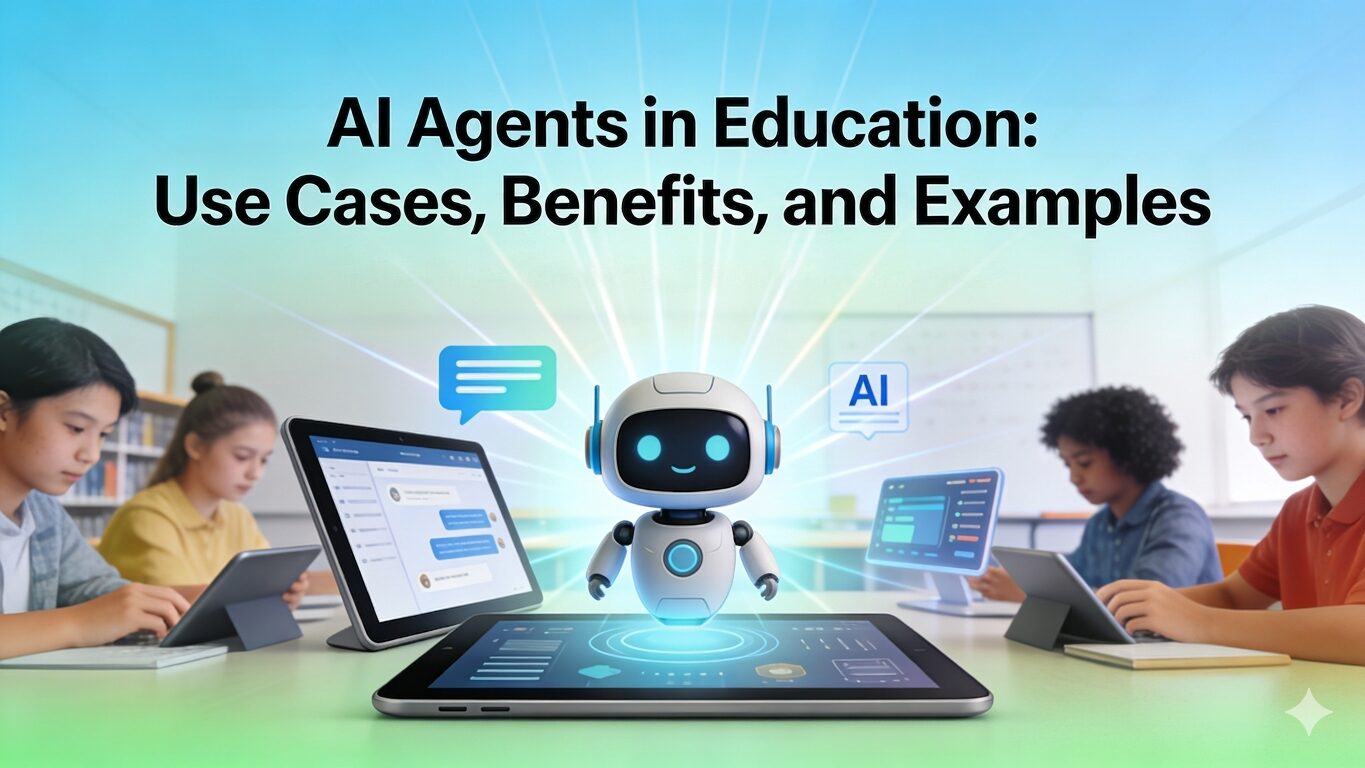
Artificial Intelligence is already a core part of how students learn today. The bigger shift now is toward agentic AI. Instead of simply waiting for prompts, AI systems can actively monitor progress, trigger actions, surface insights, and provide timely support to students and staff.
The demand for this is already clear. According to the Digital Education Council, 86% of students use AI in their studies, yet 80% say their institutions are not fully meeting expectations for AI integration. In higher education, 57% of institutions now consider AI a strategic priority.
This gap creates a significant opportunity. Institutions don’t need more generic tools; they need intelligent systems that can support learners, reduce staff workload, and improve service without making the experience feel robotic. That’s where AI agents stand out. In this article, we will explore how AI agents are transforming the education system in meaningful ways. We will look at real data, practical use cases, and real-world examples to understand their impact, so stay with us as we break it down.
What Are AI Agents in Education?
AI agents in education are software systems that can understand context, make limited decisions, and take action across a workflow. A chatbot answers a question. An agent can answer the question, check student status, recommend the next step, and route the case if human support is needed.
In practice, an educational AI agent might detect that a student is falling behind, send a reminder, suggest revision material, and notify the instructor if the pattern continues. The United States Department of Education points to AI tutoring, homework support, lesson planning, formative feedback, and teacher assistance as strong examples of how AI can support learning when humans remain in control. This distinction matters because the real value of an AI agent for education is not novelty. It is follow-through.
Why AI Agents Matter Now?
Schools, universities, and tutoring businesses all face the same pressure. Students expect faster support. Faculty need time back. Administrative teams are stretched. Educational AI agents help because they can respond at scale without turning every process into a manual task.
They also support a more personal learning experience. A strong agent can adapt messages, recommend content, and flag risk based on student behavior. That is one reason institutions exploring AI for personalized learning in education are moving beyond static automation and toward tools that can respond to each learner with more context.
The best results usually come from one simple idea: use AI to handle repetition, then let educators focus on judgment, relationships, and teaching.
Top Use Cases for AI Agents in Education
The table below shows where AI agents in education create the most value:
| Use case | What the agent does | Main benefit |
| Personalized learning | Recommends content, adapts pace, and identifies gaps | Better learner support |
| Student services | Answers routine questions, sends reminders, and routes cases | Faster response times |
| Faculty support | Draft materials, summarize data, support grading | Lower admin load |
| Admissions and onboarding | Qualifies inquiries, collects documents, and nudges applicants | Better conversion and service |
| Research support | Scans sources, summarizes findings, and organizes workflows | Faster academic work |
| Operations | Supports scheduling, attendance, and reporting | Higher efficiency |
1. Personalized Learning and Academic Support
This is the use case most people think of first, and for good reason. AI agents can monitor how students perform across lessons, assignments, and assessments. They can then recommend practice, adjust pacing, or trigger support before a learner falls too far behind.
That makes AI in education examples much more meaningful than simple content generation. Instead of only creating text, the system becomes part of a support loop. It watches, responds, and helps staff intervene sooner. For institutions focused on retention, this can be especially valuable.
The same logic also supports engagement. Timely prompts, feedback, and study guidance can keep learners active between sessions. In cohort-based models, that works even better when paired with an online group tutoring platform that already tracks attendance, participation, and progress.
2. Student Services, Admissions, and Onboarding
Many institutions lose time on repetitive student questions. Program information, deadlines, onboarding tasks, orientation updates, and basic policy queries often fill inboxes and support queues. AI agents can absorb much of that volume.
In higher education, this matters across the full student journey. An agent can support inquiry handling, application follow-up, enrollment reminders, and first week guidance. It can also escalate sensitive or high-value cases to human teams. That makes the process faster without removing human oversight.
This is also where AI agents in education, rapid deployment, and higher education become a practical topic, not just a keyword. Student service teams often need visible wins quickly. A carefully scoped agent for admissions or onboarding can show value fast, especially when linked to systems such as a tutor scheduling software or student support workflow.
3. Faculty Productivity and Teacher Workload
Teachers and faculty do not need more tools that create more tabs. They need support that removes repetitive work. AI agents can help draft lesson plans, generate first pass rubrics, summarize class performance, answer routine course questions, and assist with administrative follow-up.
The Department of Education also highlights AI support for lesson planning, classroom orchestration, and formative feedback. The point is not to replace the educator. The point is to remove low-value repetition so more time stays with students.
That is why AI adoption often overlaps with a broader push on how to reduce teacher workload. Institutions see stronger outcomes when AI is introduced as workflow support, not as a substitute for teaching judgment.
4. Higher Education Operations and Research
Higher education has a wider operational footprint than most schools. There are student services, advising, research support, academic departments, compliance needs, and large communication flows. AI agents can help across each layer.
EdTech Magazine highlights how universities are already exploring AI for service delivery, staff support, and multilingual communication. Ohio State also notes that agentic systems can assist with attendance, routine grading, learning material retrieval, and predictive risk detection.
Research is another emerging area. The Agent Laboratory paper found an 84% reduction in research expenses compared with previous autonomous research methods, though the authors also stress that human feedback improved quality at each stage. That is the right lens for higher education: AI can accelerate work, but human review still raises standards.
Examples of AI Agents in Education
The strongest content in this space includes real examples. Kira Learning, backed by Andrew Ng, is built around AI agents that support lesson planning, progress monitoring, intervention strategies, and personalized tutoring. It is a strong example of an AI agent for education designed to work with teachers, not around them.
The broader market also shows where demand is moving. EDUCAUSE found that teaching and learning is the top institutional focus area for AI use, with academic integrity, coursework, assessment practices, and curriculum design leading the list.
These examples work because they connect AI to outcomes that institutions already care about: student support, staff efficiency, and better learning design.
Best Practices for Rapid Deployment
Fast deployment sounds attractive, but poor deployment creates risk. UNESCO stresses that AI in education should be human-centered, inclusive, and equity-focused. The Department of Education makes a similar point by calling for humans in the loop, transparency, evidence of effectiveness, and strong privacy protections.
For that reason, the best rollout path is simple. Start with one use case. Define success clearly. Keep a human review point. Audit for bias and privacy. Train staff before the scale. This matters even more for institutions thinking seriously about AI ethics in education, where trust can become a real differentiator.
Conclusion
AI agents in education are no longer just a trend. They are becoming a practical way to improve student support, personalize learning, and reduce operational workload across institutions. The real impact comes from using AI to support educators and enhance decision-making, not replace it.
At Wise, we focus on building AI-powered solutions that make learning more adaptive and scalable while helping educators save time and improve outcomes. With tools like our online group tutoring platform, we enable institutions to deliver structured, engaging, and data-driven learning experiences.
As AI continues to evolve, the goal is to adopt what truly adds value. When implemented thoughtfully, AI becomes a powerful enabler that transforms how education is delivered and experienced.
Frequently Asked Questions
What are AI agents in education?
AI agents in education are systems that can understand context, make limited decisions, and take action within a workflow. They do more than answer questions. They can recommend resources, trigger reminders, route cases, and support staff with follow-up.
How are AI agents used in education?
They are used for personalized learning, student support, admissions, faculty assistance, grading support, research workflows, and institutional operations. The most effective uses combine automation with human oversight.
What are examples of AI in education?
Common AI in education examples include adaptive tutoring, automated feedback, lesson planning support, student service agents, attendance support, and research assistants. Platforms like Kira Learning show how agent-based support can work across both teaching and administration.
Can AI agents replace teachers?
No. AI can support teachers, but it cannot replace the human judgment, empathy, motivation, and ethical decision-making that education depends on. Most credible guidance now focuses on augmentation, not replacement.
How can higher education use AI agents?
Higher education can use AI agents for advising, admissions, onboarding, help desk support, coursework assistance, research workflows, and early risk detection. The best starting point is a narrow use case with clear governance, measurable outcomes, and staff training.