- Growing a modern tutoring business requires abandoning disconnected tech stacks.
- To scale efficiently, you must choose small group tutoring software that centralizes the parent journey, automates Zoom scheduling, and tracks attendance natively.
- Seamless invoicing (via Stripe and Xero) is essential for sustainable growth.
- Read on to discover the 9 proven strategies that will help you evaluate and select the perfect all-in-one platform for massive growth in 2026.
The landscape of the tutoring industry is experiencing a profound shift. What was once predominantly a one-on-one educational model has rapidly evolved into a scalable, cohort-based approach. As business owners look to maximize their revenue without endlessly expanding their payroll, small group classes, typically ranging from up to six students per session, have become the gold standard. But while the business model has scaled, the operational infrastructure often lags painfully behind.
If you are running a tutoring company today, there is a very high probability that you are suffering from a highly disconnected tech stack. This happens when you try to piece together fragmented software to run your operations: Zoom for video calls, Google Workspace for document storage, Google Classroom for homework, Calendly for trial bookings, Google Forms for enrollment, Xero for accounting, Stripe for payments, and WhatsApp for communication. It is a chaotic web of tabs, links, and lost data.
This fragmented approach might work when you have a handful of students, but it shatters under the weight of true scale. You end up spending more time on manual administration, chasing unpaid invoices, hunting down lost Zoom links, and manually tracking attendance, than you do on pedagogy or business development. The solution lies in choosing the right infrastructure. In this comprehensive guide, we will explore 9 proven strategies to choose the best small group tutoring software in 2026, ensuring that your technology works for you, rather than you working for it.
Strategy 1: Demand Seamless Parent Journey Management
In the K-12 tutoring sector, you are rarely selling directly to the end-user (the student). Your primary customer is the parent. Therefore, any small group tutoring software you evaluate must inherently understand and optimize the parent journey. From the moment a parent lands on your website to the day their child graduates from your program, the experience must be frictionless.
Most generic software treats all users equally, failing to distinguish between the buyer and the learner. An optimized platform will allow you to manage the entire pipeline with as little manual administration as possible. This means having a dedicated parent portal where they can view schedules, pay upcoming term invoices, track their child’s academic progress, and communicate directly with tutors or administrators. When parents are empowered to self-serve, checking attendance records or downloading past receipts without emailing your support desk, your operational overhead plummets.
Furthermore, the software must integrate seamlessly into your broader ecosystem. The evolution of educational technology dictates that standalone tools are no longer sufficient. Your platform needs to act as the centralized hub for the entire family experience, allowing parents to manage multiple siblings under a single, unified household account.
Strategy 2: Look for Frictionless Trial Booking Workflows
The lifeblood of any growing tutoring business is new leads. When a prospective parent visits your website, the friction between their initial interest and booking a discovery call or trial class must be absolutely zero. If they have to fill out a static contact form and wait 24 hours for an email reply proposing available times, you have likely already lost them to a competitor.
Top-tier small group tutoring software will provide native, customizable booking links that you can embed directly on your website. Think of it as a specialized version of Calendly, but deeply integrated into your tutoring database. These booking workflows should allow the parent to view your real-time availability, select a time slot for a consultation or a trial cohort, and fill out a detailed intake questionnaire.
This automated workflow ensures that by the time you or your admissions team jump on the call, you already know the student’s age, their current academic struggles, their curriculum (such as the Australian curriculum for Years 1-10), and their specific goals. This level of professional presentation significantly boosts conversion rates and is a critical step when looking to grow a tutoring business in Australia or beyond.
Strategy 3: Ensure Native Video Conferencing Integration (The End of Lost Links)
Perhaps the most universal pain point for online educators is managing video conferencing links. Relying on an external Zoom account means you are constantly generating meetings, copying links, pasting them into emails or Google Classroom, and fielding frantic “Where is the link?!” messages from parents five minutes before a class begins.
When evaluating small group tutoring software, native video integration is non-negotiable. Look for platforms where Zoom is bundled directly into the infrastructure. In a native integration, neither the tutor nor the student needs to handle URLs, meeting IDs, or passwords. The tutor simply logs into their dashboard and clicks a single “Start” button. The students log into their portal and click a single “Join” button.
Beyond simplicity, this offers immense security and administrative control. Because the meetings are launched through the platform, attendance is logged automatically based on join and leave times. Furthermore, the sessions can be automatically recorded and stored securely on your own servers (like AWS), rather than languishing on individual tutors’ local hard drives. This protects your intellectual property and ensures strict adherence to child safety and privacy protocols.
Strategy 4: Prioritize Comprehensive Content & Homework Management
A tutoring session is only part of the educational journey. The spaces between sessions, where homework is assigned, completed, and graded, are equally critical. Managing this via Google Drive folders is a recipe for disaster. Permissions get tangled, files get lost, and tracking who has submitted what requires endless cross-referencing against a spreadsheet.
Your chosen software must feature a robust, centralized content library. Tutors should be able to upload PDFs, worksheets, YouTube videos, and interactive assignments directly into a specific cohort’s dashboard. More importantly, the system should support templates. If you teach Year 8 Mathematics, you should only have to build the curriculum once. Every time a new cohort begins, the software should allow you to import the entire 10-week curriculum template with a single click, complete with drip-feed settings to release content week by week.
When it comes to homework, the feedback loop must be seamless. Students (or their parents) should be able to upload their completed work directly to the platform. The tutor can then review it, assign a grade based on custom criteria (e.g., correctness, handwriting, methodology), and leave typed or annotated feedback. The moment the tutor clicks submit, an automated notification should alert the student and parent that feedback is ready to view.
Strategy 5: Require Automated Attendance and Interactive Learning Tools
Manual administrative tasks are the enemy of scale. When you are managing dozens of cohorts and hundreds of students, asking tutors to spend the first five minutes of every class taking attendance is a massive waste of billable time. The right small group tutoring software will automate this entirely.
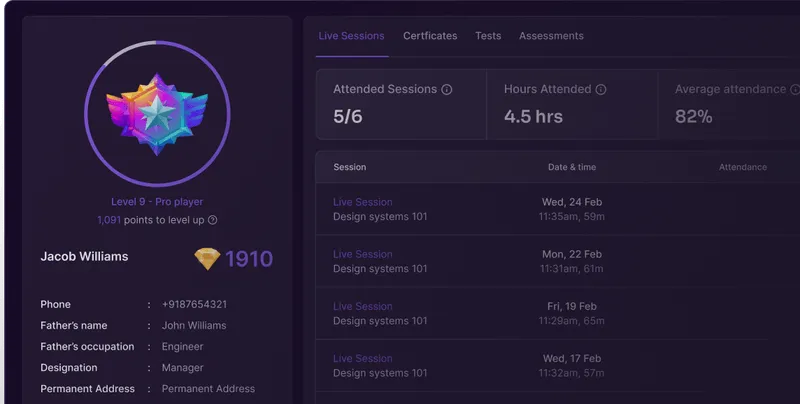
Because the video conferencing is native to the platform, the software should track exactly who logged in, exactly what time they joined, and exactly when they left. This data should instantly populate into your administrative dashboards, allowing you to track chronic absenteeism and intervene before a student drops out. Retention is the highest-leverage metric for tutoring businesses, and real-time attendance data is the key to maintaining it.
Additionally, modern platforms leverage AI to enhance the learning experience. Advanced systems will automatically generate AI summaries of the session transcripts, providing revision notes for students immediately after the class ends. Some platforms like wise even take this a step further, automatically generating a 5-question interactive quiz based entirely on the unique concepts discussed during that specific hour, driving engagement without requiring any extra effort from the tutor.
Strategy 6: Demand Integrated Payment Tracking and Invoicing
Financial administration can easily consume a full-time role if not properly automated. Many tutoring businesses operate on a term basis (e.g., 10-week terms tied to the school calendar) and require upfront payments. If you are manually generating invoices in one software, emailing them to parents, waiting for bank transfers, and manually reconciling those payments, you are limiting your capacity to scale.
Your chosen software must feature native payment gateways. By integrating directly with platforms like Stripe, parents can securely input their credit card details during the enrollment process. Whether you are charging a one-time fee of $2,000 for a term, or setting up recurring monthly subscriptions, the software should handle the transaction, generate the receipt, and instantly grant the student access to the cohort upon successful payment.
Furthermore, for those looking for robust financial reporting, integrations with leading accounting software like Xero are highly desirable. By pushing payment data directly to your accounting suite, you eliminate manual data entry errors and ensure your books are always perfectly reconciled. For more insights on scaling these operations, explore our guide on large tutoring center software.
Strategy 7: Built-in CRM and Pipeline Management
Acquiring a lead is only the first step; managing that lead through a pipeline is where the actual revenue is generated. While you don’t necessarily need the complexity of enterprise sales software, your small group tutoring platform must have foundational Customer Relationship Management (CRM) capabilities.
When a parent fills out an inquiry form or books a discovery call, their details should automatically populate into your central database as a “Lead” or “Prospective Learner.” The system should allow your administrative team to assign custom tags to these profiles, tracking their status as they move from inquiry, to trial scheduled, to trial completed, and finally, to enrolled and paid.
Without this pipeline visibility, leads inevitably fall through the cracks. A built-in CRM ensures that you can filter your database to find every parent who completed a trial last month but hasn’t yet enrolled, allowing you to send targeted follow-up campaigns. If you are just getting off the ground, setting up these pipelines early is critical, a concept we discuss thoroughly in our guide on how to start a tutoring business in Australia.
Strategy 8: Empower Tutors with Custom Access and Analytics
As your team grows, managing tutor schedules becomes a complex puzzle. You need a system that respects your staff’s time while giving you ultimate oversight. Superior tutoring software will feature a two-way Google Calendar sync. Tutors can input their specific working hours (e.g., 8:00 AM to 5:00 PM in their local timezone), and the software will absolutely prevent you from double-booking them or scheduling them during personal appointments.
Beyond scheduling, the platform should act as a specialized tutor scheduling software that tracks their performance and utilization. Administrators should have access to organization-wide calendars that easily filter by instructor, revealing who is over-utilized and who has capacity to take on new cohorts.
Crucially, the software should automate your payroll calculations. By assigning a specific payout rate (whether hourly or per-session) to each tutor’s profile, the system can automatically calculate exactly what you owe them at the end of the month based on the automated attendance logs of the sessions they actually conducted. This eliminates disputes and saves hours of spreadsheet math.
Strategy 9: Insist on Mobile Accessibility (and White-Labeling)
We live in a mobile-first world. While tutors might conduct sessions from laptops, parents and students are checking schedules, messaging administrators, and reviewing homework from their smartphones. If your platform isn’t highly optimized for mobile devices, engagement will plummet.
The very best small group tutoring software offers dedicated mobile apps for both iOS and Android. Even better is the option for true white-labeling. Imagine parents downloading an app from the App Store that features your company’s logo, your branding, and your exact color scheme. It projects immense professionalism and instills deep trust in your service.
This short video talks about the advantages of a branded Mobile App
Furthermore, mobile apps drastically improve communication logistics. Relying on SMS reminders for sessions can become incredibly expensive as your student base grows. With a dedicated app, you can rely on free, automated push notifications to remind students of upcoming classes or pending homework deadlines. For businesses operating internationally, integrating these reminders via familiar channels is also highly effective, a strategy covered in our deep dive on WhatsApp tutor scheduling notifications.
Conclusion: Breaking Free from the Disconnected Stack
Building a highly profitable tutoring business requires a relentless focus on efficiency. Every minute your team spends copying Zoom links, hunting for Google Docs, or cross-referencing bank transfers is a minute stolen from student success and business growth. The 9 strategies outlined above provide a rigorous framework for evaluating your operational infrastructure.
By demanding a platform that offers native video integration, automated attendance, robust parent portals, seamless payment gateways, and built-in pipeline management, you transition from playing administrative catch-up to leading your market. Whether you are scaling a boutique local agency or building a national network, the right small group tutoring software is the ultimate catalyst for sustained, massive growth.
For more insights into optimizing your operations, explore our comprehensive reviews on platforms like tutoring business management software and start streamlining your entire educational ecosystem today.