
The private tutoring sector in the UK is experiencing exponential growth, with revenues projected to reach USD 494 billion by 2024. It is expected to rise steadily. This has become possible as thousands of tutoring businesses are emerging each year.
However, as your tutoring agency or tutoring business expands, so will your tax obligations, and thus knowing and understanding VAT registration for tutoring agencies and tutoring businesses becomes increasingly crucial. VAT rules differ depending on whether you are an individual tutor, a commission-based tutoring agency, or a tutoring business providing lessons directly.
In this article, we will explain VAT registration for tutoring agencies, VAT registration for tutors, and whether tutoring services need to register for VAT.
Understanding the Three Tutoring Models and the VAT Implications
Value Added Tax (VAT) is a consumption tax that is applied to various goods and services in the UK. Once the tutoring agency’s or tutoring business’s turnover crosses a certain limit, they need to register with HMRC to collect and pay VAT on taxable tutoring services.
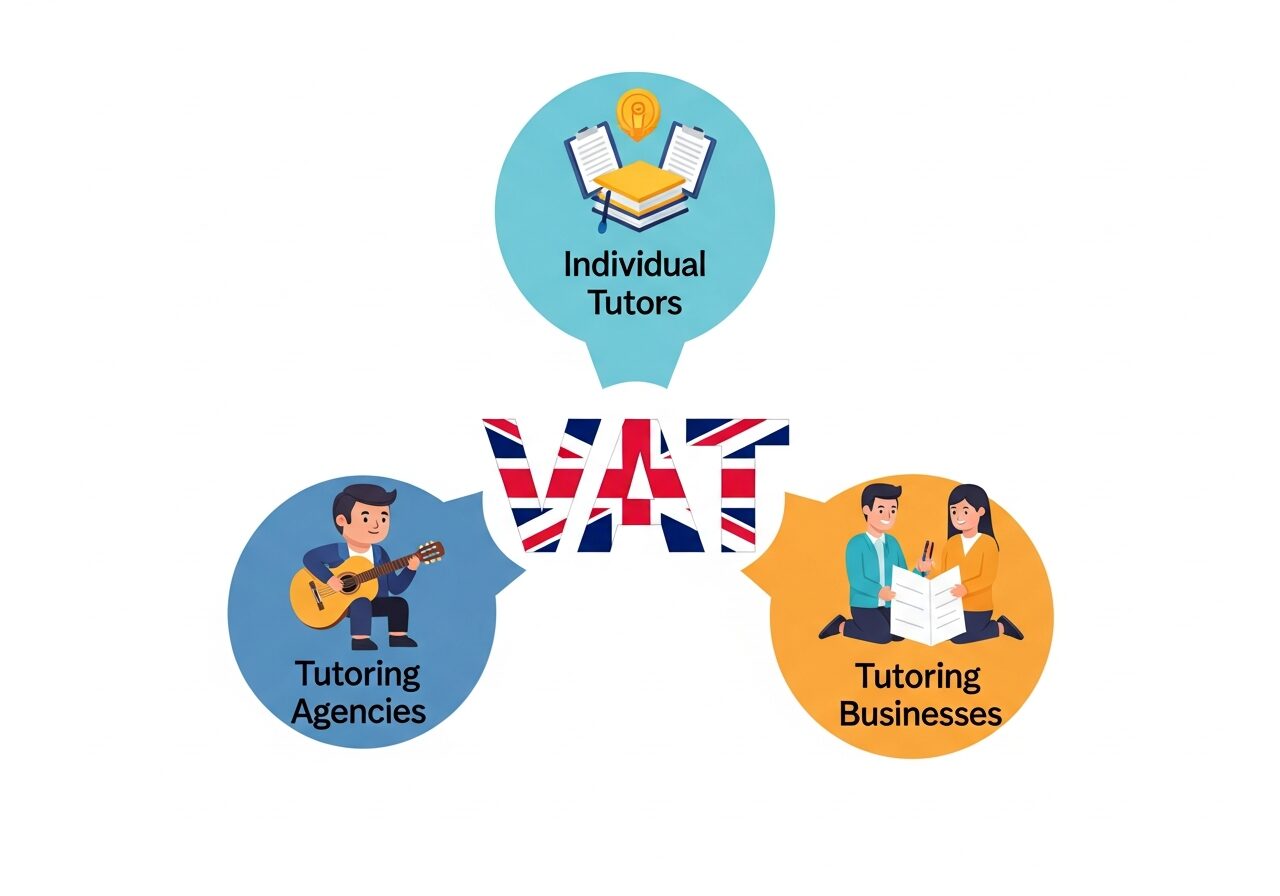
Here are the three models HMRC recognises:
- Individual Tutors – self-employed tutors teaching directly
- Tutoring Agencies (Commission Model) – matchmakers charging a commission
- Tutoring Businesses (Direct Service Providers) – businesses delivering lessons in their own name
VAT Implications for Individual Tutors, Tutoring Agencies, and Tutoring Businesses
Each model has different VAT obligations, and each answers the question Do tutoring services need to register for VAT differently. Here are the different models and the VAT implications:
1. Individual Tutors
If the tutor teaches subjects “ordinarily taught in schools or universities,” such as:
- Maths
- English
- Sciences
- Languages
- Humanities
Then their services are VAT exempt. This means VAT registration for individual tutors is not required, regardless of revenue.
However, tutors teaching vocational or specialist subjects must follow VAT rules. VAT Applies If the Tutor Teaches Taxable Subjects Such As:
- Coding & programming
- Photography
- Dance, drama, performing arts
- Digital design
- Music production
- Life coaching, career coaching
When an individual tutors and teaches the subjects mentioned above, and their taxable turnover exceeds £90,000, VAT registration for tutors becomes mandatory.
2. Tutoring Agencies (Working on Commission Model)
A tutoring agency connects tutors to students but does not deliver the tutoring. The tutor teaches, and the agency earns a commission.
How the Agency Model Works
- The agency introduces the tutor
- The tutor teaches the student
- The tutor receives their share
- The agency keeps a commission (e.g., 20–30%)
VAT Rules for Tutoring Agencies
Here are the points that are to be remembered:
- VAT applies only to the agency’s commission.
- VAT does NOT apply to the tutor’s teaching fee if the tutor teaches VAT-exempt subjects
For example:
Suppose the lesson fee is £40 under a tutoring agency, with the individual tutor receiving £30 and the £10 being the tutoring agency’s commission. Then, the applicable VAT will be charged on £10 (commission).
The tutoring agency needs to register for VAT when the commission earnings (NOT total lesson fee) exceed £90,000 in 12 months.
3. Tutoring Businesses (Direct Service Providers)
A tutoring business provides tutoring directly under its own brand. The tutors may be employees or contractors, but the business is the provider. A tutoring business is one where:
- The business sells tutoring services directly
- Parents pay the organisation
- The business controls lesson delivery
- Tutors work under the company’s methods and brand
- The business is responsible for educational outcomes
VAT Rules for Tutoring Business
VAT payable by the tutoring business depends on the subject being taught. Here is the classification:
- Academic Subjects → VAT Exempt
If the business teaches subjects aligned with the National Curriculum or university education, the service is VAT-exempt.
- Non-academic Subjects → VAT Taxable
Subjects such as coding, robotics, dance, digital media, soft skills, and workshops are VAT taxable if the turnover exceeds £90,000. The VAT is charged on the entire lesson fee.
What is the Threshold for VAT?
The current VAT registration threshold in the UK is £90,000 in taxable turnover within any rolling 12-month period.
What Counts Toward the Threshold?
- Individual Tutors: Only taxable subjects
- Tutoring Agencies: The agency only takes a commission as income
- Tutoring Businesses: Entire revenue from taxable subjects
VAT-Exempt vs VAT-Taxable Tutoring Subjects
HMRC’s guidance (VAT Notice 701/30) outlines what counts as VAT-exempt education.
VAT-Exempt Subjects Typically Include:
- Maths
- English
- Science
- Languages
- History
- Geography
- School curriculum subjects
- Exam preparation (GCSE, A-Level, IB)
VAT-Taxable Subjects Typically Include:
- Coding
- Robotics & AI
- Dance, drama, performing arts
- Music production
- Digital design, photography
- Life coaching, career coaching
- Soft skills & professional workshops
How to Register for VAT?
Although it may seem complicated, registering for VAT is actually quite simple. Here are the steps that you can follow:
Step 1: Calculate your turnover to confirm whether it has reached or is expected to exceed £90,000 soon.
Step 2: Register as either an individual tutor, tutoring agency, or tutoring business.
Step 3: Complete your VAT registration for tutors online via the HMRC portal. You’ll get a VAT registration number and your filing deadlines.
Step 4: If you use tutor scheduling software, enable VAT features to automatically calculate and add VAT to invoices.
Step 5: Submit VAT returns quarterly, pay any outstanding VAT to HMRC, and reclaim VAT on eligible purchases.
Common VAT Mistakes
No matter how many years a tutoring agency has been operating, it is still easy to fall into VAT traps. It is necessary to watch out for:
- Assuming all tutoring is VAT-exempt
- Forgetting to register after crossing the £90,000 threshold
- Ignoring online tutoring revenue
- Failing to separate exempt and taxable services
- Not updating VAT details in tutoring software
It is necessary to avoid these mistakes, as they ensure you are compliant and build financial credibility over time.
Are There Any Benefits of VAT Registration?
Although it may feel unnecessary at times, VAT registration for tutoring agencies can be beneficial. Here is how being VAT compliant is fruitful:
Professional Image
Clients often prefer VAT-registered providers. Being VAT-registered signals professionalism. Parents and institutions often view VAT-registered tutoring agencies or tutoring businesses as more established and reliable.
VAT Reclaims
Once registered, your tutoring agency or tutoring business can reclaim VAT on costs such as tutor management software, tutor scheduling software, marketing campaigns, rent, and office supplies, thereby lowering your overall operating expenses.
Scalable Growth
If you are looking to expand your tutoring business or partner with schools and organisations, being VAT-registered simplifies contracts and compliance requirements.
Better Bookkeeping
Integrating your VAT processes with modern tutoring software automates invoicing, reporting, and filing, saving time and reducing the risk of costly errors.
A Competitive Edge
Many government and school contracts prefer working with a VAT-registered individual tutor, tutoring agency, or tutoring business, thereby opening new revenue opportunities.
Conclusion
Individual tutors, tutoring agencies, and tutoring businesses must view VAT registration for tutors as more than just a compliance task. It is an essential consideration for a professional, scalable, and, more importantly, financially stable tutoring business. Whether you are an independent tutor or managing a growing team, knowing when and how to register for VAT and which services are exempt can save you from costly mistakes.
So, if you plan to expand or start your tutoring business, taking VAT registration seriously today will lay the foundation for long-term credibility, growth, and financial stability.
Frequently Asked Questions
Do tutoring service providers need to register for VAT?
Tutoring service providers, whether it is an individual tutor, tutoring agencies, or tutoring businesses, have to register for VAT when their annual taxable turnover exceeds £90,000 (the 2024–25 VAT threshold). However, not all tutoring services are taxable; those teaching subjects ordinarily taught in schools or universities may be exempt from VAT. It’s important to regularly monitor their income to determine whether VAT registration is necessary.
Are private tutors VAT exempt?
Yes, private tutors teaching school subjects (such as Maths, English, or Science) are typically VAT-exempt, provided they’re teaching independently and not through a company structure. However, if they teach non-academic or vocational subjects (e.g., dance, music production, coding), those services may be subject to VAT post threshold.
How do I register my tutoring agency for VAT?
You can easily register online via the HMRC website. Once your application is approved, you’ll receive a VAT registration number. You then have to start charging VAT on taxable services, update your invoices, and file VAT returns, ideally using tutor management software to automate the process.
What are the benefits of VAT registration for tutoring agencies?
VAT registration can help your tutoring agency or tutoring business to reclaim tax on business expenses, build client trust, and prepare for future growth and expansion. It also simplifies contracts with educational institutions and enhances financial transparency, particularly when supplemented by tutor scheduling software to ensure accurate tracking and management.
What happens if my tutoring agency or tutoring business fails to register for VAT in a timely manner?
If your tutoring agency or tutoring business exceeds the £90,000 threshold but fails to register promptly, HMRC may charge penalties and backdated VAT on your income. The longer the delay, the higher the fine. To avoid penalties, set up alerts or use tutor management software to regularly monitor your turnover.