
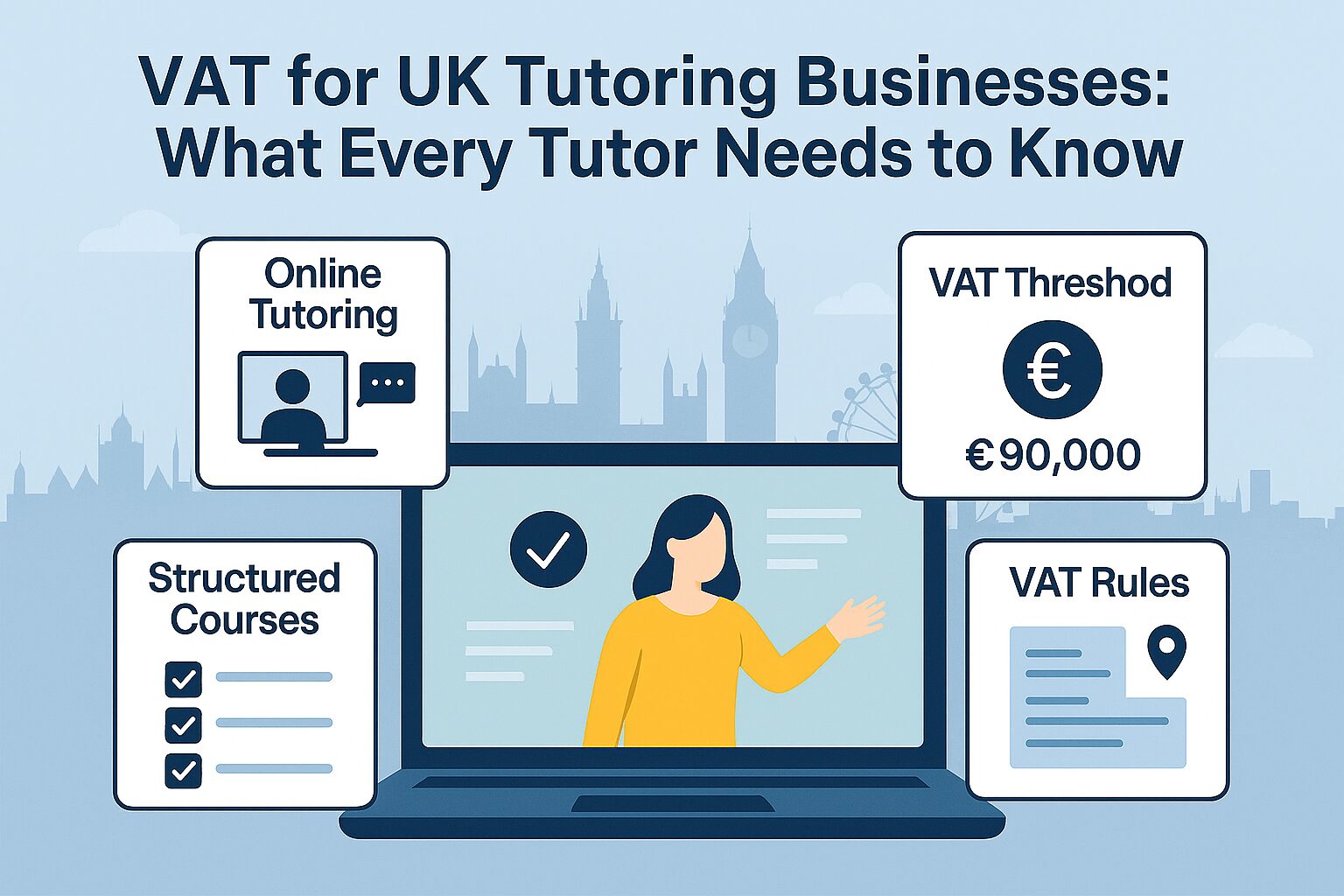
TL;DR
Running a tutoring business in the UK? Here’s what you need to know about VAT:
- VAT applies to most UK tutoring businesses, especially if you employ tutors, subcontract, or provide structured courses.
- The VAT exemption for ‘private tuition’ generally does not apply to companies or agencies.
- Once your taxable turnover exceeds £90,000 in any 12-month period, you must register for VAT.
- Online tutoring, group sessions, and recorded courses often trigger VAT liability.
- VAT rules depend on where your students are located, and whether your lessons are live or automated.
- Plan early, maintain clear records, and get professional advice before scaling the business.
Introduction:
As the tutoring industry in the UK matures, more agencies are moving from small operations to professional, structured businesses, employing multiple tutors, offering online sessions, and even selling recorded courses.
With that growth comes one major financial consideration: VAT. And unlike many other taxes, VAT can quietly affect your pricing, your profits, and your compliance.
Let’s break down how VAT really works for UK tutoring businesses, and how you can stay compliant without losing focus on teaching.
1. What is VAT and why it matters to Tutors
Value Added Tax (VAT) is a tax added to most goods and services sold in the UK. The standard rate is 20% (HMRC, VAT rates).
If you’re a tutor or tutoring business, VAT affects:
- How much you charge your students or clients,
- Whether you can reclaim VAT on expenses (like Zoom subscriptions or teaching & learning software), and
- Whether you must register your business with HMRC.
The VAT registration threshold is £90,000 in taxable turnover as of April 2024,which means if your VAT-eligible income exceeds that figure in any 12-month period, you must register for VAT (HMRC: VAT Registration Rules).
Even if you’re below the threshold, understanding whether your tutoring business is VAT-exempt or VAT-taxable helps you plan ahead, especially if you’re scaling.
2. Why most tutoring businesses must charge VAT
While ‘private tutoring’ provided personally by an individual may be VAT-exempt, this exemption does not apply to businesses, agencies, or group operations.
As explained in HMRC VAT Notice 701/30:
- The exemption applies only when tuition is supplied by an individual on their own account.
- When tuition is supplied by a business employing or subcontracting teachers, the service becomes standard-rated.
This means:
- If your company employs tutors or contracts them through your platform, VAT applies to your services.
- If your business provides structured courses (group sessions, test prep, or skill-based training), VAT is due on those offerings.
- If your company sets the price and invoices parents or institutions directly, it’s considered the supplier, not the individual tutor and must comply with VAT obligations.
Relevant expert summary: M+A Partners – Personal Tuition VAT
3. When your business’s tuition becomes VAT-taxable
Let’s simplify: tutoring businesses fall into the VAT-taxable category when any of the following apply:
- You operate as a limited company or LLP providing tutoring.
- You hire multiple tutors.
- You deliver courses outside the national curriculum (e.g., coding, test prep, or soft skills).
- You provide pre-recorded or automated online lessons.
- You cross the £90,000 taxable turnover threshold.
Essentially, when your business structure or services move beyond the traditional one-person setup, you’re supplying education commercially and that means VAT applies.
Industry insight: The VAT People – VAT for Tutors and Agencies
4. VAT and online tutoring: The ‘Place of Supply’ Rules
If your tutoring business delivers online sessions, VAT depends on where your students are based.
According to HMRC Notice 741A – Place of Supply of Services:
- If your students are in the UK, UK VAT rules apply.
- If your students are outside the UK, the services may be outside the scope of UK VAT.
However, if your business delivers pre-recorded or automated courses, those are classed as digital services.
And under HMRC’s VAT on Digital Services, digital services sold to UK consumers are always VAT-taxable, regardless of the turnover.
That means:
- Live, interactive lessons (e.g., via Zoom) are treated as education services.
- Recorded, automated, or self-paced courses are treated as digital services and VAT always applies.
If your company operates globally, track where your students are based and classify each type of service correctly.
5. VAT Registration: when and how
Once your business’s taxable turnover hits £90,000, VAT registration becomes mandatory. Here’s the process:
- Calculate taxable turnover, include all revenue from services that are subject to VAT (exclude exempt services).
- Register online via HMRC’s VAT portal.
- Once registered, your business must:
- Charge VAT (20%) on eligible lessons or services.
- File quarterly VAT returns.
- Display your VAT registration number on invoices.
- Keep digital records under Making Tax Digital (MTD) rules.
You can also voluntarily register before hitting £90,000, beneficial if your clients are VAT-registered schools, corporates, or institutions who can reclaim VAT.
6. Common VAT mistakes in tutoring businesses
Even established tutoring firms make avoidable errors. Here are the big ones:
1. Mixing exempt and taxable services
If your company offers both curriculum-based lessons (potentially exempt) and other taxable services (e.g., coding, music, group lessons), you must separate and divide revenue correctly.
2. Misclassifying online courses
Many tutoring companies assume that online courses are automatically VAT-exempt. They’re not. Recorded courses count as digital services and are always VAT-taxable.
3. Treating contractors Like Employees
If you operate through self-employed tutors, clarify whether they supply services directly (to avoid liability confusion). Incorrect classification can shift VAT obligations to your business.
4. Not tracking the VAT threshold
Businesses that grow quickly often cross the £90,000 limit without realising it. Use accounting tools or software to monitor monthly rolling turnover and avoid late registration penalties.
7. Managing mixed supplies and recordkeeping
If your business offers both exempt and taxable services, HMRC requires you to:
- Divide turnover clearly between categories.
- Apply VAT only to taxable supplies.
- Maintain detailed records showing how revenue was split.
- Ensure invoices clearly identify which services are subject to VAT.
Refer to HMRC VAT Notice 706 – Partial Exemption for guidance on handling mixed supplies.
Good bookkeeping here avoids errors and builds trust during VAT reviews or audits.
8. Can you reclaim VAT on business expenses?
If you’re VAT-registered, you can reclaim VAT on most business-related purchases:
- Software (CRM tools, Zoom, scheduling, LMS platforms)
- Marketing and advertising spends.
- Office equipment and computers.
- Accounting, consulting, or legal services.
However:
- You cannot reclaim VAT on costs linked to VAT-exempt activities.
- If you provide both exempt and taxable services, apply partial exemption rules for input tax recovery.
Useful source: HMRC VAT Notice 706
9. Agencies and platforms: Principal vs. Agent VAT rules
If your tutoring business operates as a platform or agency, VAT treatment depends on whether you act as the principal or agent:
- Principal: You set the price, invoice the student, and collect payment → VAT applies to the full fee.
- Agent: You only introduce tutors and charge a commission → VAT applies only to your commission.
Misclassifying your role can result in under- or over-charging VAT. See The VAT People’s guide for more insight on agency vs. principal distinctions.
10. Fixing VAT errors and avoiding penalties
If you discover that your business has been charging VAT incorrectly or not at all, you can correct it through HMRC’s voluntary disclosure process (within 4 years).
To resolve VAT issues safely:
- Get a VAT review from a specialist firm (e.g., The VAT People or Law Hound).
- Recalculate output VAT and input VAT correctly.
- Update invoices and systems to reflect proper VAT treatment.
- File adjustments in your next VAT return.
Proactive correction shows compliance and reduces risk of penalties.
11. Preparing for Growth: VAT strategy for tutoring businesses
VAT shouldn’t be an afterthought, it should be part of your business strategy. Here’s how to prepare:
- Track revenue monthly and stay ahead of the £90,000 threshold.
- Separate exempt and taxable income in your accounting system.
- Plan pricing with VAT inclusion in mind, especially if you’ll need to register soon.
- Structure contracts with tutors and clients clearly to reflect your VAT obligations.
- Get professional advice before launching new products, platforms, or cross-border services.
For further clarity, the Tutors Association Tax Resource Page provides additional industry guidance.
12. Conclusion
VAT is a fact of life for UK tutoring businesses, especially those growing beyond a small setup.
Once you employ tutors, run structured programs, or sell digital courses, you’re likely operating in VAT territory.
Understanding this early helps you:
- Avoid financial surprises.
- Stay compliant with HMRC.
- Maintain a transparent pricing system.
- Focus on your core goal, delivering great and accessible education.
When in doubt, always refer to HMRC VAT Notice 701/30 and seek professional advice before making structural or pricing changes.
Frequently Asked Questions (FAQs):
1) Do I always have to charge VAT on my tutoring services?
Not always. If you’re an individual tutor providing one-to-one tuition in subjects commonly taught in schools/universities, you may qualify for the “private tuition” exemption. But if you operate through a company, or you employ/contract tutors, or your subject isn’t widely taught in schools, you must charge VAT.
2) At what point do I need to register for VAT?
When your taxable turnover (i.e., income from supplies that are not VAT-exempt) exceeds £90,000 in any rolling 12-month period, you must register for VAT. (This threshold changes occasionally, so check the current limit with HM Revenue & Customs.) You can also register voluntarily earlier.
3) I run online group sessions and sell recorded courses, do the rules differ?
Yes, they do. If you provide recorded or automated digital courses, these are treated as digital services and are VAT-taxable even if you’re below threshold depending on location of student. If you deliver live interactive tuition to UK students, standard UK VAT rules apply. So you’ll need to check where your students are and the format of your service.
4) Can I reclaim VAT on my expenses if I’m VAT-registered?
Yes, if you’re VAT-registered and you buy things wholly for the purpose of making taxable supplies, you can reclaim the VAT on those costs. But if you also provide VAT-exempt services, you’ll need to apply the “partial exemption” rules to correctly apportion input tax.
5) My business does both exempt and taxable tuition (e.g., school curriculum + test prep). What should I do?
You’ll need to keep separate records for exempt supplies and taxable supplies. Make sure your invoices clearly state which service is taxable or exempt. And you must apply correct VAT treatment for each part and maintain clear bookkeeping so you can justify the split if audited.