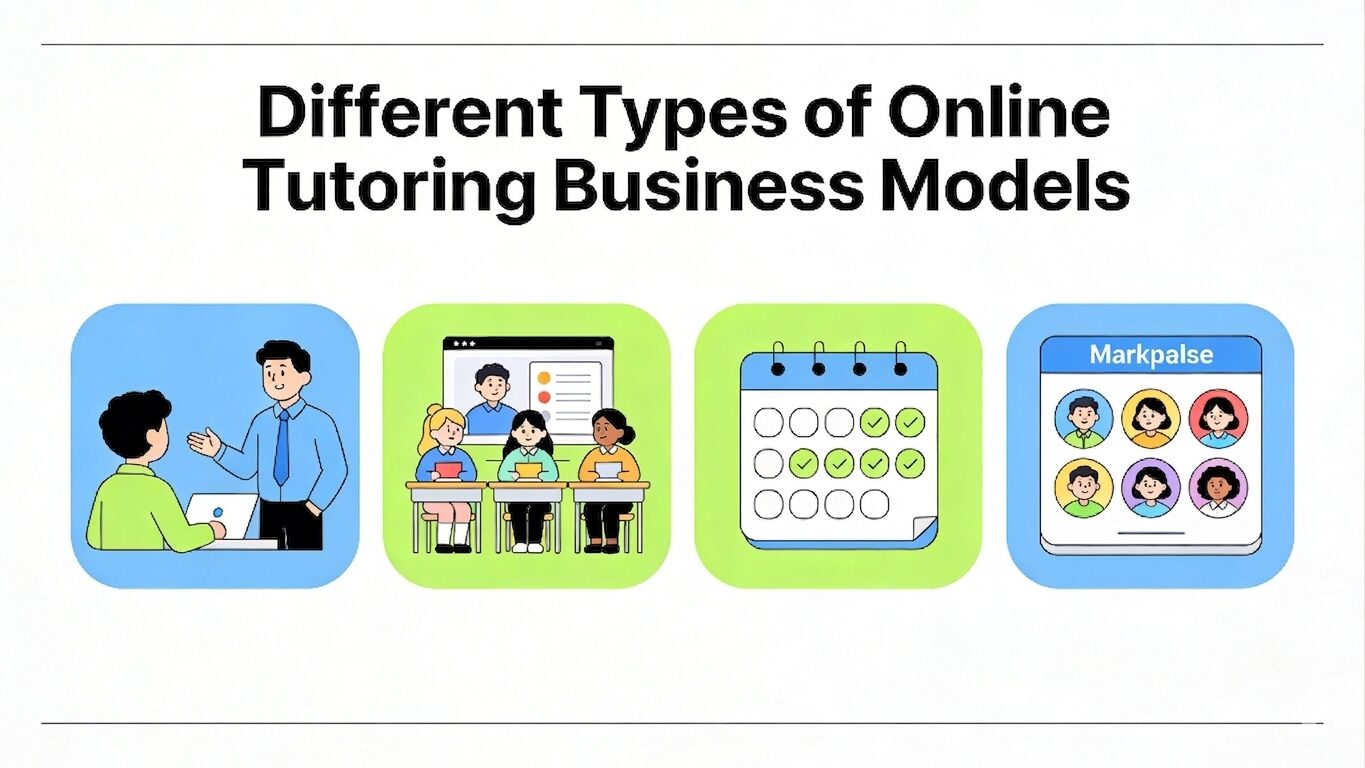
Three tutors start businesses in the same month. One is still trading hours for dollars two years later. One burned out. The third runs group cohorts, earns recurring revenue, and has not taken a one-on-one booking in the past 6 months. The subject they teach is not what sets them apart. The global online tutoring market crossed the $10 billion mark in 2024. All three had access to the same opportunity. What they chose for their online tutoring business model made the difference.
Most tutoring businesses do not fail because the teaching is bad. They fail because the structure was never built to grow.
One-on-One Tutoring: The Natural Starting Point
A colleague needed IELTS prep, and you had a free evening. A neighbor’s kid was failing math, and the money helped. One-on-one tutoring rarely starts as a business decision. You accumulate students before you have a name for what you are doing: no cohort to fill, no content to build, no system required before your first session. Show up, teach, and within a few weeks, you know more about how that student learns than anyone else does.
The problem shows up later. Six sessions a day at $60 each, five days a week, gives you a ceiling. A fixed one. The only levers are rate increases or a model change.
When One-on-One Makes Sense
- Your student cannot wait for a group to catch up: Weekly sessions mean a parent is watching closely. They want to see their child move forward on their child’s timeline, not whenever a cohort of six is collectively ready for the next topic.
- You have not found your sharpest material yet: Private sessions are research. After three months, you will know which of your explanations land without fail, which topics break every student at the same point, and what separates your teaching from anyone else offering the same subject.
- You need word of mouth before you need anything else: A student who moves up a grade in two months generates conversations you cannot buy. That student’s parent tells three people in the same week. None of that starts without a result, and results come fastest in a format with no one else in the room.
Group Tutoring: The First Real Leverage Move
There is a specific kind of tiredness that hits when you are fully booked, and your revenue has not moved in three months. You are doing everything right, and the number stays flat. That is usually what pushes a tutor toward group tutoring.
One session. Six students. Each pays $35. That is $210 for the same hour you were billing $60. Something else shifts, too, something most tutors do not see coming. A student who freezes up in a private session will answer a question in front of peers. Competition can sometimes focus that one-on-one attention that sometimes cannot. In test prep, that room energy is worth more than an extra hour of solo drilling.
Running groups on a WhatsApp thread and a shared Zoom link works for about two weeks. Then someone misses a session, someone else wants a recording, and a third student pays late. You are now an admin assistant for your own business.
When Group Tutoring Makes Sense
- Your subject has a problem every student hits at the same place: IELTS writing, SAT critical reading, and GCSE math. The student who already solved that problem three weeks ago becomes part of your teaching without you having to ask them. That does not happen in a private session.
- You want students who feel like they belong somewhere: A student in a Tuesday evening cohort who knows the other five by name is not thinking about canceling. The one who books you the same way they book a plumber is always one bad week away from dropping off.
Self-Paced Courses: Passive Income or Passive Neglect?
The pitch is obvious. Record once, upload, collect payments while you sleep.
Sarah from Dublin built a self-paced IELTS course in 2023. Took her six weeks to record. Sold four copies in three months. Not because the content was bad. She had 23 students and no email list. Nobody knew it existed. Self-paced courses need an audience before they need content, and most tutors build them the other way around.
Where self-paced content works cleanly is as an add-on. A business running live group sessions offers a revision library that students access between sessions. The tutor adds zero live hours. Students have somewhere to go at 11 pm on a Wednesday when they get stuck. That is far more sustainable than launching a standalone course from scratch.
Marketplace vs. Independent Platform: Who Owns the Student?
Platforms like Wyzant and Preply solve a real problem. They bring you, students, when you have no brand and no list. That speed has a price that most tutors only see once they are already dependent on the platform.
Marketplace commissions run between 15% to 40% per session. On a $60 booking, that is up to $24 gone before it reaches you. Worse, the student relationship belongs to the platform. You cannot email students directly, move them to a package, or build anything on top of that relationship without permission. If the algorithm changes, your income disappears overnight.
Building on an independent platform costs more upfront. But a business doing 100 sessions a month at $60 pays up to $2,400 in marketplace commission. Purpose-built tutor scheduling software costs a fraction of that monthly. Every student you book through it is yours: the contact list, the relationship, and the ability to sell them something else next month.
Subscription and Hybrid Models: The Hardest to Build, the Best to Own
Recurring revenue is what separates a tutoring job from a tutoring business. A student paying a flat monthly fee provides you with income that does not reset to zero each month. You stop selling one session at a time.
The difficulty is retention. A subscription only holds if students keep seeing progress. One who skips sessions will have the charge resent and be canceled by month three. These models reward tutors who already have strong engagement. They punish those who hope the model will fix a retention problem that the teaching has not solved.
Hybrid models layer two or more formats under one business. Weekly one-on-one sessions, a monthly group workshop, and a self-paced library, all under one subscription. The revenue per student is the highest among all structures. But it demands real infrastructure, a platform that handles in-person tutoring and online delivery, automated invoicing, and session tracking across multiple formats.
Comparing the Core Models
| Business Model | Revenue Per Hour | Scalability | Complexity |
| One-on-One | Low ceiling | Low | Low |
| Group Tutoring | Medium to high | Medium | Medium |
| Self-Paced Courses | High with the audience | High | Medium |
| Marketplace | Medium minus commission | Low | Low |
| Independent Platform | High | High | Medium |
| Subscription or Hybrid | Highest | High | High |
Conclusion
The online tutoring business model you choose determines your revenue ceiling, your hours, and whether your business can grow without you personally delivering every session. Starting with one-on-one is fine. Staying there by default comes with a cost.
When you are ready to build toward a model that fits where you actually want to go, start your free trial with Wise and see what becomes possible.
Frequently Asked Questions
What is the most profitable online tutoring business model?
Subscription and hybrid models generate the most revenue per student over time. Combining weekly live sessions with a self-paced resource library earns more per student per month than selling individual bookings. The trade-off is that these models need strong retention systems to sustain them.
Can I run more than one type of online tutoring business model at the same time?
Yes, and most businesses that grow past the founder stage do exactly that. The key is a platform that handles scheduling, payments, and student tracking across all formats without requiring you to manage each one separately. Without that, the admin load cancels out the revenue gains.
How do I choose between a marketplace and an independent platform?
A marketplace works when you are starting and need students fast. An independent platform makes sense once you have a consistent student base and want to stop losing up to 40% of every session fee. The online tutoring market is forecast to reach nearly 23 billion dollars by 2030, and the businesses best placed to grow are those that own their student relationships.
Is self-paced content worth building?
Only if you already have an audience to sell it to. Validate your material through live sessions first, find the lessons that land best, then record those as modules students can revisit between sessions.
What does a group tutoring model need that one-on-one does not?
Automated attendance, session recording, in-session engagement tools, and invoicing that handles multiple students per session. Tutors who manage all of this manually find that the admin time erases the revenue advantage the group format was supposed to create.