
TL;DR
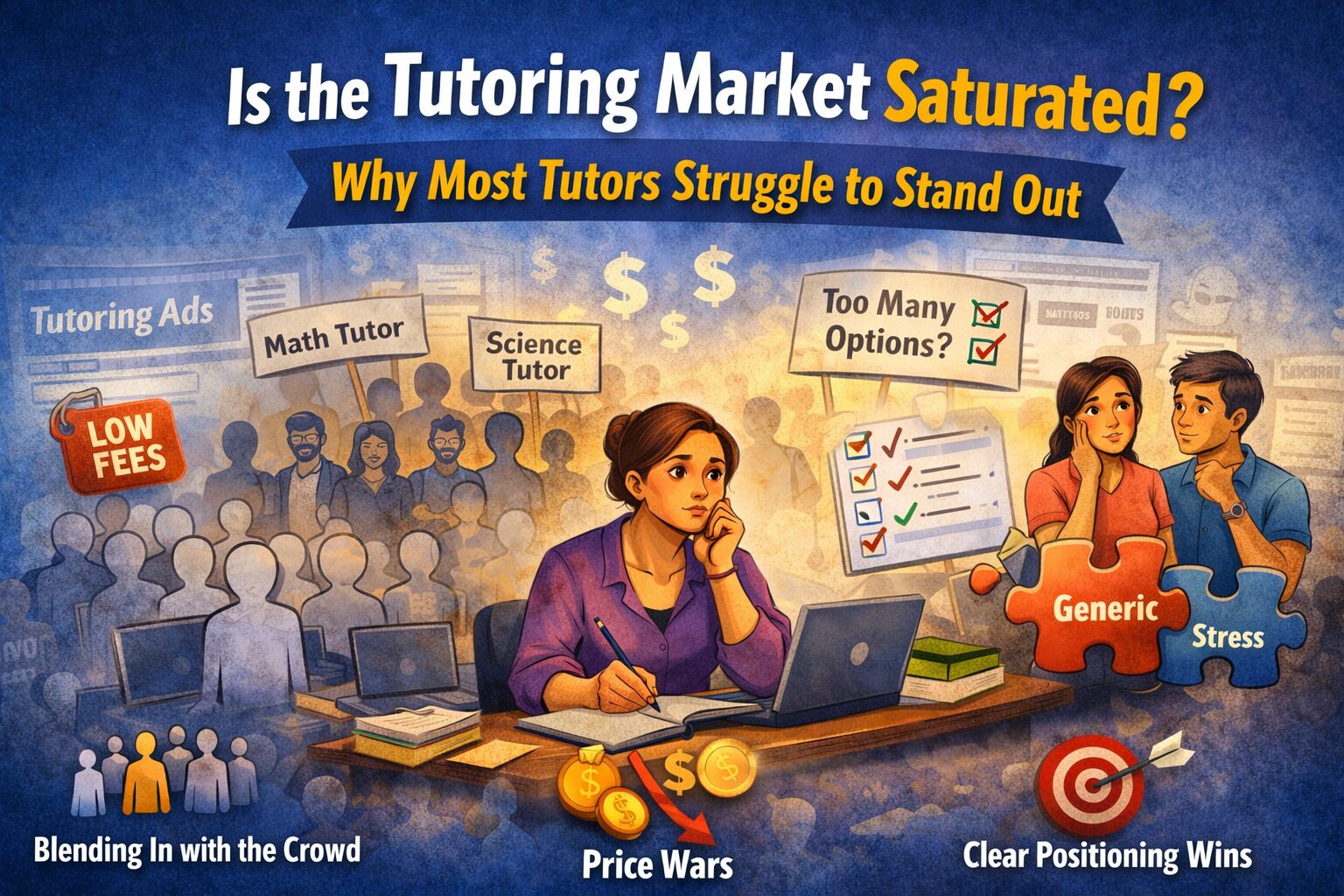
- Most tutors feel invisible, not because demand is low, but because their services sound the same in comparison to hundreds of others competing.
- Generic positioning forces tutors into price competition, leading to lower confidence, inconsistent enquiries, and burnout.
- Parents and students don’t choose the “best” tutor; they choose the tutor who feels most relevant to their exact problem.
- The belief that the market is saturated often masks deeper issues: unclear niche, weak messaging, and lack of professional systems.
- Tutors who clarify their positioning and systemise delivery consistently grow, even in highly competitive local and online markets.
Introduction: Why ‘Market Saturation’ is the most common fear among Tutors
For many tutors and tutoring business owners, market saturation feels like the defining challenge of the industry today. Whether they teach online or in person, tutors frequently describe the same frustrations: too many competitors, too many ads, too many tutors offering similar services, and not enough students willing to pay sustainable rates.
This perception often leads to discouragement. Tutors may hesitate to invest further in their business, delay raising prices, or question whether tutoring can realistically become a long-term career. New tutors, in particular, can feel overwhelmed before they even begin, believing that the market is already “too full” to succeed.
However, this belief deserves closer examination. The tutoring industry continues to expand globally, driven by academic pressure, competitive exams, parental expectations, and the flexibility of online learning. If demand is increasing, why does competition feel so intense at the individual tutor level?
The answer lies not in the size of the market, but in how most tutoring services are positioned within it.
The Tutoring Market is growing, but standing out is harder
Online tutoring has made it easier than ever to start teaching. Tutors no longer need a physical centre or high upfront costs. While this has opened doors for many, it has also increased the number of tutors offering similar services.
From a parent’s perspective, this creates confusion for them to choose between online and offline. Search results, social media posts, and tutoring platforms often show dozens of tutors offering the same subjects, the same grades, and similar promises. When everything looks similar, parents struggle to decide.
Marketing research shows that when people are faced with too many similar choices, they don’t carefully compare each one. Instead, they look for quick signs that help them decide. In tutoring, this often means choosing based on:
- Price
- Availability
- What exact problem do they solve for the child?
This is how a growing market can feel saturated, even when demand is healthy.
Where Market Saturation really exists
Market saturation does not affect all tutors equally. It mainly affects generalist tutors, those who try to teach everyone and everything.
Examples include:
- “Math tutor for all grades”
- “Online tutor for school students”
- “Private tuition for all subjects”
These descriptions are not wrong, but they are very common. When many tutors describe themselves the same way, parents struggle to see meaningful differences. Economic research shows that in such situations, competition becomes focused on price rather than value.
This is why tutors in these broad categories often feel constant pressure to lower fees or take on more students just to maintain an income.
For example, if 10 tutors in the same London locality all advertise “Maths tuition for grades
6 – 12, online and in-person, guaranteed passing,” parents are unlikely to evaluate the teaching approach or outcomes. With no meaningful difference between listings, they shortlist based on price, availability, or who replies first, not teaching quality.
This is why tutors in these broad categories often feel constant pressure to lower fees or take on more students just to maintain income.
How parents actually choose Tutors
Parents don’t usually choose tutors by reading every qualification or comparing teaching styles in detail. Research in services marketing shows that when outcomes are uncertain, as they are in education, people look for clarity and reassurance.
Parents typically want answers to simple questions:
- “Does this tutor understand my child’s situation?”
- “Have they helped similar students before?”
- “Do they specialize in this subject or exam?”
When a tutor clearly answers these questions, parents feel more confident. This idea is supported by signalling theory, which explains that when people can’t directly judge quality, they rely on signals like clarity, focus, and professionalism.
This is why relevance often matters more than experience alone.
For example, a parent in London looking for GCSE Maths help for a Year 11 student stuck at a Grade 4(standard pass) is far more likely to choose a tutor who says: “I help GCSE
High school students stuck at grades 4 – 5 improve exam techniques before mocks for better results,” over a tutor advertising: “Maths tutor for all high schoolers.”
Even if both tutors are equally qualified, the first feels immediately more relevant to the parent’s problem, making the decision easier, safer, and specific.
When a tutor clearly answers these questions, parents feel more confident. This is why relevance often matters more than experience alone.
Why generic positioning makes Tutoring feel harder
When tutors present themselves broadly, several problems tend to appear over time.
First, marketing becomes tiring and inconsistent. Broad messages don’t strongly connect with any one group, so enquiries come and go unpredictably or start feeling questionable.
Second, price pressure increases. Without a clear reason to choose one tutor over another, parents compare fees. Behavioural research shows that people fear losses more than they value gains, which explains why many tutors avoid raising prices even when they should.
Third, burnout becomes more likely. Research on burnout in service professionals shows that lack of control and constant negotiation are major contributors to emotional exhaustion. Tutors often experience this as long hours due to extensive lesson preparation to engage students, but this results in low satisfaction and declining motivation.
These struggles are often blamed on market saturation, but they are usually the result of unclear positioning.
Why specialising helps Tutors stand out
Specialising simply means being clear about who you help and what problem you solve. Research across professional services shows that specialists are trusted more easily than generalists because they feel safer choosing them.
In tutoring, specialisation could look like:
- Focusing on a specific exam or syllabus
- Working with a particular age group
- Supporting students with a specific learning challenge
- Helping students achieve a clear outcome, such as exam resits
For example, instead of advertising “STEP Tutoring for Year 13 students to get into the best universities.”
A more specific way to position as a tutor to show specialisation is, “I help Year 13 students prepare for STEP exams and entrance assessments required by top London universities for undergraduate admissions.”
This immediately signals a clear academic stage, exam type, and outcome. Students aiming for competitive universities recognise the relevance instantly, while generic enquiries naturally filter out.
Specialising does not reduce demand. It reduces confusion.
Tutors who specialise often notice that while they may receive fewer enquiries at first, those enquiries are more serious, more committed, and less price-sensitive. Read here for more insights on this topic.
Why Tutors Hesitate to Narrow Their Focus
Many tutors worry that specialising will limit opportunities. They fear turning students away or choosing the wrong niche. This fear is understandable.
Behavioural economics explains this through loss aversion. People feel the pain of potential loss more strongly than the benefit of potential gain. Tutors worry more about the students they might lose than the clarity they might gain.
In practice, tutors who specialise usually find that their work becomes easier, not harder. Communication improves, students stay longer, and referrals increase because people know exactly who to recommend them to.
Why systems matter in a competitive market
Clear positioning is essential, but it is not enough on its own. Parents also care deeply about reliability and organisation.
Research on service quality shows that people judge services not only on results, but also on consistency, communication, and trust. In tutoring, this means:
- Clear scheduling and reminders
- Simple and transparent payments
- Easy communication
- Visible student progress
When these elements are missing, parents may lose confidence, even if teaching quality is high.
This is where tools like Wise come in. Wise helps tutoring businesses manage scheduling, payments, student information, and learning in one place. By reducing admin confusion and improving consistency, Wise helps tutors present a more professional and trustworthy experience, something that matters greatly in crowded markets.
Importantly, this is not about growth at any cost. It is about making your tutoring business easier to understand, easier to trust, and easier to recommend.
Why do some Tutors grow while others get stuck?
Research across service businesses shows that long-term success usually depends on three things:
- Clear focus
- Consistent experience
- Simple, reliable systems
Tutors who grow define who they help, communicate clearly, and use systems to support their work. Tutors who struggle often rely on memory, manual tools, and broad messaging, which becomes harder to sustain as competition increases.
Teaching skill matters, but clarity and organisation determine whether that skill translates into a stable business.
Conclusion: Market saturation is a wakeup call, not a dead end
It’s easy to believe the tutoring market is saturated when growth feels slow, enquiries are inconsistent, or parents push back on pricing. But the evidence tells a different story. Demand for tutoring continues to grow, and families are actively looking for support. What has changed is not the size of the market, but the standard required to stand out within it.
Tutors who struggle in ‘crowded’ markets are rarely failing because they lack skill or experience. They struggle because their offering is hard to understand, easy to compare, and difficult to trust at first glance. When tutors position themselves broadly, rely on informal processes, and compete mainly on price, they feel the pressure of competition most strongly.
On the other hand, tutors and tutoring businesses that grow sustainably do a few things differently. They are clear about who they help and what problem they solve. They communicate that clearly in their messaging. And they back it up with a professional, consistent experience that parents can rely on.
This is where structure makes a real difference. Clear scheduling, transparent payments, organised communication, and visible progress are no longer nice to have; they are part of how parents judge quality. Platforms like Wise support this shift by helping tutors move away from scattered tools and manual work toward a calmer, more reliable way of running their business. The result is not just efficiency, but confidence, for both tutors and parents.
Market saturation is not a sign that tutoring is no longer viable. It is a signal that tutoring has matured as an industry. The tutors who adapt by becoming clearer, more focused, and more professional will continue to find opportunities. Those who don’t will feel the pressure first.
Tutoring is still a powerful, meaningful, and sustainable career. Saturation is not the end of opportunity; it is a prompt to do things differently.
FAQs (Frequently Asked Questions)
1. Is the tutoring market actually saturated?
No. Research from organisations like the OECD, the World Bank, and industry analysts shows that demand for tutoring is still growing. What feels like saturation is usually intense competition among tutors offering very similar services without clear differentiation.
2. Why does it feel harder to get students now than before?
Because parents are exposed to more options than ever. When tutors sound similar, parents compare price, availability, or convenience instead of value. Tutors who clearly explain who they help and how they help stand out more easily, even in competitive markets.
3. Do tutors really need to specialise to succeed?
In most cases, yes. Specialising makes it easier for parents to understand whether you are the right fit for their child. It reduces comparison, improves trust, and often leads to better student commitment and retention.
4. Won’t specialising reduce the number of students I can work with?
It may reduce the number of enquiries initially, but it usually improves the quality of enquiries. Tutors who specialise often find that students stay longer, are more motivated, and are less sensitive to price.
5. Is teaching quality alone not enough anymore?
Teaching quality is essential, but it is no longer enough on its own. Parents also judge reliability, communication, organisation, and professionalism. How your tutoring business runs is now part of how your teaching is evaluated.
6. How do systems help tutors stand out in a crowded market?
Systems reduce confusion and increase consistency. Clear scheduling, automated reminders, transparent payments, and organised student records all help parents feel confident. In crowded markets, this reliability becomes a competitive advantage.
7. When should a tutor start using a tutoring management platform?
As soon as the admin starts to feel heavy or growth feels chaotic. Many tutors wait too long and burn out first. Introducing structure early makes growth calmer and more sustainable.
8. Can tutoring still be a long-term career?
Yes. Many tutors build stable, fulfilling careers and businesses. The key is treating tutoring as a professional service, not just a series of lessons. Clear positioning, fair pricing, and strong systems make long-term success far more achievable.