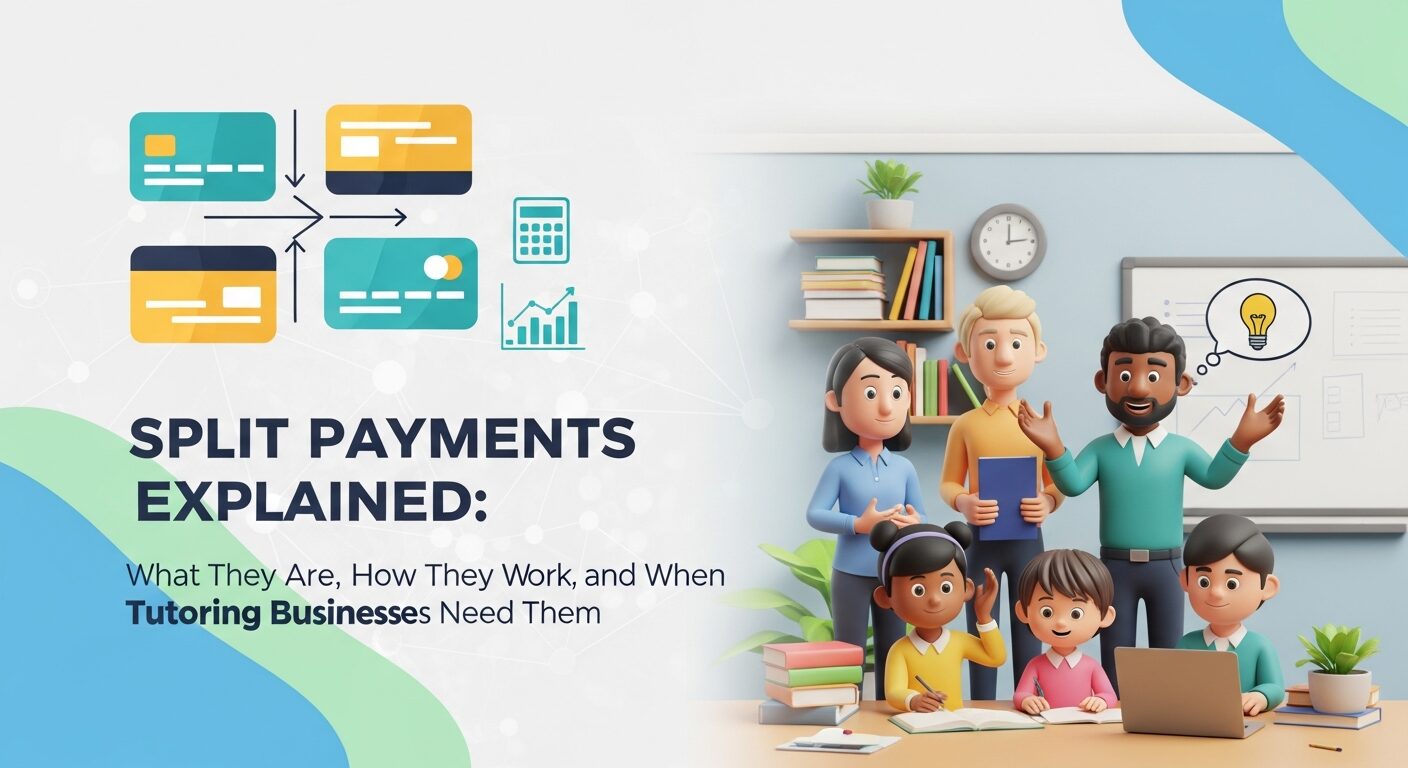
In the platform-driven economy, payments are not only about collecting money from clients; they are also about disbursing revenue instantly and transparently. It applies to tutoring businesses operating under the Employment Agency Model, as payments are often shared among agencies, tutors, and software providers.
That’s where split payments come in. If you’ve ever asked what a split payment is or how split payments work in a real-world tutoring business scenario, then this guide breaks it all down for you.
For tutoring agencies, understanding the key concepts of split payments is not optional; it is foundational.
What Is Split Payment?
Let us start with the basics. Split payment is a digital payment mechanism in which a single customer transaction is automatically divided among multiple recipients in predefined proportions, without manual intervention.
Traditionally, the client first pays the platform or the tutoring agency. Then the tutoring agency pays the tutor.
But with split payments, the client pays only once. The money is instantly and automatically distributed to:
- Tutor
- Agency
- Platform
- Affiliates (if any)
Split payments not only automate payment distribution but also automate trust, transparency, and revenue distribution at scale.
How Does Split Payment Work?
As the concept of split payments is quickly gaining traction, many decision-makers want to understand how they work before adopting and integrating them into their existing workflows. Here is how it all works:
Step 1: The client makes a payment
A student or parent books a class through your tutor scheduling software and pays online.
Step 2: The platform identifies the payment and revenue rules
If you are using a tutor management software, it already stores information about:
- Tutor commission percentage
- Platform fee
- Agency margin
- Taxes & gateway charges
Step 3: The payment gets split automatically
The system then instantly divides the payment and:
- Tutor receives their share.
- Agency gets its cut
- The platform keeps its service fee.
Step 4: Fund settlement
Each party receives their share of the money directly into their linked bank account or wallet.
Step 5: Real-time reporting
After all payments are settled, you can also check information like:
- Earnings per tutor
- Platform revenue
- Payout history
- Tax records
This automation is why split payments are now a core feature of every modern marketplace platform.
Why Split Payments Are Necessary for Tutoring Businesses?
Running a tutoring agency or a tutoring business today is not just about managing tutors and students; it’s about managing multi-party financial flows at scale.
Here’s why split payments are no longer optional for tutoring businesses operating under the Employment Agency Model:
- It is a necessary compliance requirement as per HMRC.
- It helps in treating VAT clearly and correctly.
Security, Compliance & Trust in Split Payments
Because split payments distribute funds among multiple stakeholders, security and compliance are non-negotiable. Modern split payment systems ensure:
- Tokenised card data
- Encrypted fund routing
- Compliant escrow architecture
- Automated GST and TDS handling
- Full audit trails
When Does a Tutoring Business Actually Need Split Payments?
The need for split payments depends on the model you use to operate your tutoring business. If you are a tutoring business operating under the Employment Agency Model, then split payment is mandatory. However, it is not mandatory for tutoring businesses that are not operating under the Employment Agency Model.
Besides being a core compliance requirement, here are three situations where split payments move from being optional to necessary:
1. When You Work With Freelance or Contract-Based Tutors
If your tutors are not salaried employees, you must handle payouts based on factors like:
- Number of sessions taught
- Variable subject-wise rates
- Commission-based earnings
So, split payment in such a case allows you to automate complex revenue-sharing without manual intervention.
2. When Tutors Want Timely Payouts
Tutors today are looking for faster payouts, daily/weekly settlements, and a transparent earnings breakdown. Understanding how split payments work is necessary, as they enable frictionless, scheduled, or real-time settlements.
3. When Your Business Operates Like a Marketplace
You definitely need split payments if your model resembles platforms like Preply or Wyzant. You can then automate business aspects like:
- Platform fees
- Tutor commissions
- Taxes
- Discounts
Scaling up can be difficult if your systems do not support split payments.
4. When You Have Many Tutors With Different Rates
Any tutoring business looking to expand will reach a point at which manual calculations become risky and prone to disputes. When your tutoring business scales up, there are certain aspects that you have to deal with, like:
- Different experience levels
- Specialised subjects
- Premium tutors
- Seasonal pricing
5. When You Offer Multiple Service Types
Split payments become necessary when your platform supports:
- One-on-one classes
- Group classes
- Workshops
- Subscription learning
- Recorded course sales
6. When You Want to Scale to Multiple Cities or Countries
As a growing tutoring business grows, you will eventually offer your services across different cities, states, and even countries. Every region will have:
- Tax rules
- Commission norms
- Payout timelines
Split payments with automated rules can help scale tutoring businesses without many financial bottlenecks.
7. For Transparent Accounting & Reporting
Businesses must adopt split payments if they are struggling with issues like:
- Earnings reconciliation
- Tutor disputes
- Payout mismatches
- Tax reporting
With split payments, you can get auto-generated earning statements, commission breakdowns, and a clear and transparent edge.
8. When You Want to Build Tutor Trust
Your tutors are literally your product. Without transparent, on-time payouts, tutors will eventually leave, spread negative word-of-mouth, and the experience can be affected. Adopting split payment helps to:
- Eliminates ambiguity
- Increase payout reliability
- Enhance tutor loyalty
Future of Split Payments in Tutoring Platforms
As AI-powered marketplaces grow, split payments will evolve beyond simple revenue sharing. The tutoring industry is rapidly shifting from institutions to platforms, and split payments are the financial engine powering that shift.
The trends that are expected include:
- Smart contracts for tutor payouts
- Performance-based auto-bonuses
- Embedded finance inside tutor scheduling software
- AI-driven commission optimisation
- Real-time global micro-settlements
What are the Features to Look for in Tutoring Software that Offers Split Payment Integration?
Not all split payment systems work in the same way. When evaluating platforms, ensure your tutoring software offers these essentials:
- Multi-party payout support
- Tax deductions are automated.
- Custom commission rules for every tutor
- Real-time earning dashboards
- Escrow-based holding (for dispute protection)
- Global payment gateway support
- Refund & chargeback handling
- Compliant with tax laws
Conclusion
Split payments are mandatory if you are a tutoring business operating under the Employment Agency Model. Once a tutoring business understands what split payments are and how they work, it becomes easier to operate with precision, trust, and, more importantly, compliance. For your tutoring business, split payments ensure compliance, remove financial bottlenecks that slow growth, and let your platform scale confidently, transparently, and efficiently.
Frequently Asked Questions
What is split payment in a tutoring business?
Split payment is a mechanism in which the fee a student or a parent pays gets automatically divided among multiple parties, typically the tutor, the tutoring agency, and the platform, based on predefined rules. Instead of manually calculating commissions each time, split payments help ensure that all payments are instant, transparent, and innovative.
Do tutoring businesses require split payments?
For tFor tutoring businesses that operate under the Employment Agency Model, split payments are mandatory. Even the tutoring businesses that use the Employment Agency Model, split payment is compulsory for them. Even when your tutoring business is not operating under the Employment Agency Model, split payment can ease financial bottlenecks, although it is not mandatory.
Can split payments help my tutoring business operate internationally?
Yes. When your tutoring platform works with tutors or students from foreign countries, split payments can handle currency conversions, international settlements, regional tax rules, and local compliance requirements. This makes it easier to expand your tutoring business globally without building complex custom systems.
Are split payments needed if I have only a few tutors?
Yes, if you are a tutoring business that operates under the Employment Agency Model, split payment is mandatory even if you have only a few tutors. Otherwise, it is not entirely needed.