
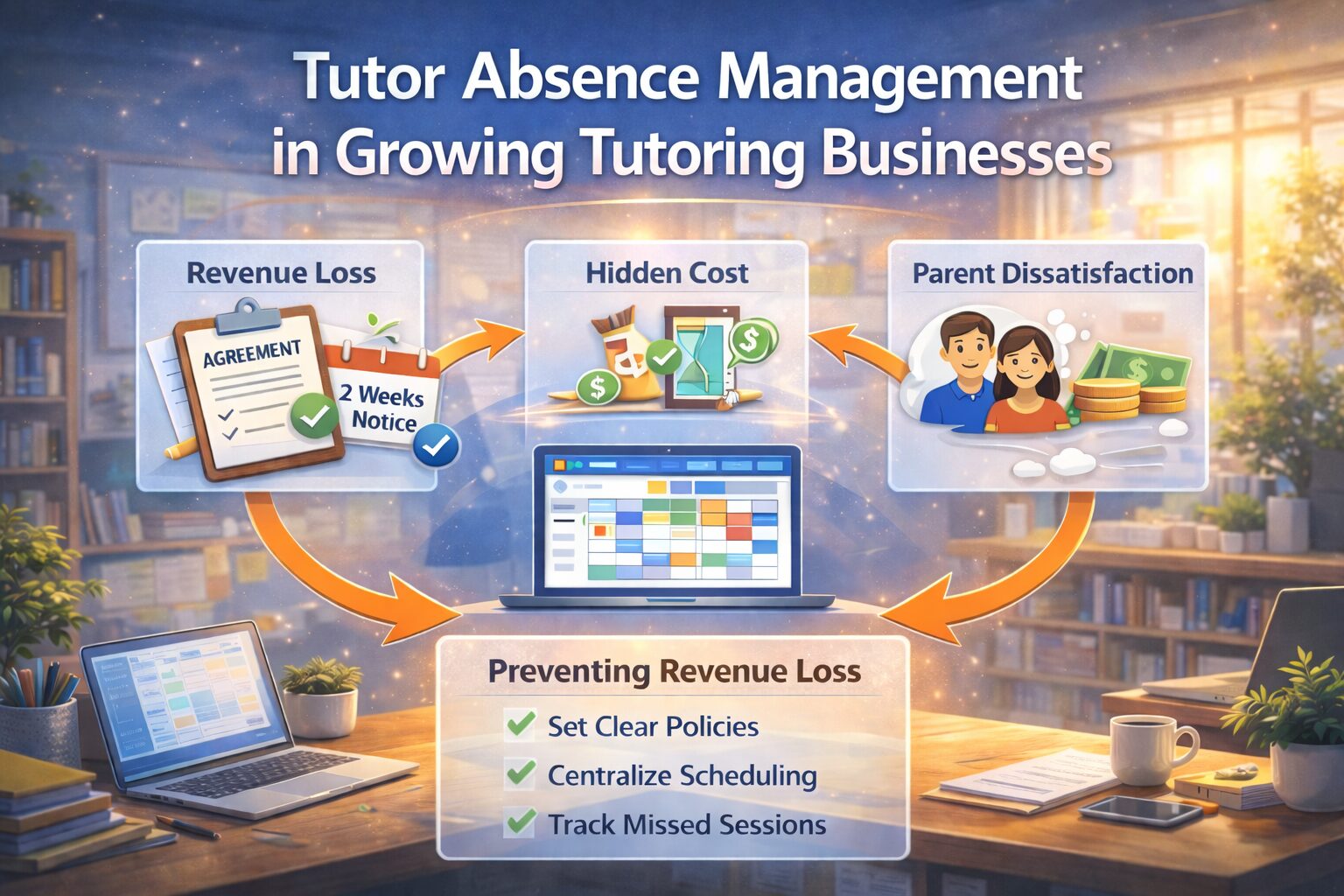
TL;DR
- Tutor absences are one of the most common operational issues in tutoring businesses, yet most organisations handle them informally without clear systems.
- Cancelled or disrupted sessions affect not only immediate revenue but also student engagement, parent trust, and long-term retention.
- Research in supplementary education consistently shows that learning continuity and routine play a major role in student progress and perceived value.
- As tutoring businesses grow, manual coordination methods such as spreadsheets and messaging apps become unreliable and increase administrative burden.
- Structured tutor absence management, supported by systems like Wise Tutor Management, helps reduce disruption, protect revenue, and enable sustainable growth.
Introduction
Tutor absences are an unavoidable part of running a tutoring business. Most tutoring organisations rely on flexible work arrangements, part-time educators, and tutors who balance teaching alongside university studies or other professional commitments. Illness, examinations, family emergencies, and sudden schedule changes are therefore not exceptional events; they are part of daily operational reality.
Despite this, tutor absences are rarely treated as a process that deserves intentional design. In many businesses, they are managed reactively. When a tutor becomes unavailable, a coordinator scrambles to reschedule, find a replacement, or issue a credit. While this approach may work at a very small scale, it becomes increasingly fragile as the business grows.
What often goes unnoticed is that tutor absences rarely exist in isolation. A cancelled session disrupts learning routines, creates uncertainty for parents, and adds pressure on administrative teams. Over time, repeated disruption changes how families perceive the tutoring service. Even when teaching quality is strong, inconsistency undermines confidence.
For growing tutoring businesses, this issue becomes more than a scheduling inconvenience. It becomes a source of hidden revenue loss, operational fatigue, and reputational risk. Tutor absence management, therefore, is not about eliminating all cancellations. It is about building reliable systems that reduce disruption and preserve trust when absences occur.
Why tutor absences matter more in tutoring than in schools
To understand the impact of tutor absences, it is important to recognise how tutoring differs from formal schooling. Schools operate with built-in redundancy, substitute teachers, predefined timetables, and institutional continuity allow lessons to proceed even when an individual teacher is absent.
Tutoring businesses do not have this structural buffer. Sessions are often built around a one-to-one or small-group relationship between a specific tutor and a specific student. When that tutor is unavailable, the session itself is at risk. Without preparation, replacement becomes difficult, and cancellation is often the default outcome.
When sessions are cancelled, families do not simply lose an hour of teaching. They lose a sense of continuity. Homework plans are disrupted, exam preparation schedules shift, and students struggle to regain their learning rhythm. Over repeated occurrences, the perceived effectiveness of tutoring begins to decline, even if tutors themselves are competent.
This structural vulnerability makes tutor absence a particularly sensitive issue in the tutoring industry.
Learning continuity and why routine matters
A consistent body of education research demonstrates that learning is cumulative and routine-dependent. Students benefit from predictable schedules, regular reinforcement, and ongoing feedback. When these elements are interrupted, learning efficiency declines.
In practical terms, this means that missed sessions have consequences beyond content coverage. Students may forget previously learned material, lose motivation, or feel uncertain about expectations. For younger learners and students already struggling academically, these disruptions can be particularly damaging.
From a tutoring business perspective, this matters because perceived learning progress is directly linked to retention. When students feel that tutoring is inconsistent, families begin to question its value, regardless of the tutor’s individual capability.
How tutor absences lead to hidden revenue loss
In tutoring businesses, revenue is directly tied to delivered sessions. Each scheduled class represents a fixed hour that can only be delivered once. When that session is cancelled due to tutor’s absence, the opportunity to generate revenue from that hour is permanently lost.
In most cases, this loss does not appear as a single large issue. Instead, it accumulates gradually through cancelled sessions, postponed classes that are never recovered, and credits that remain unused. Because these gaps occur across multiple tutors and weeks, they are often difficult to track.
Over time, businesses may notice a growing disconnect between enrolment numbers and actual revenue. Student intake increases, but delivered hours do not rise proportionately. This is often a utilisation problem rather than a demand problem.
Common contributors to absence-related revenue leakage include:
- Sessions cancelled too late to arrange a replacement
- Rescheduled classes that quietly drop off
- Substitute sessions that are discussed but never confirmed
- Inconsistent attendance tracking
- Credits issued without structured follow-up
Individually, these issues may appear manageable. Collectively, they reduce predictability in revenue and make financial planning increasingly difficult for growing tutoring businesses.
Why informal absence handling breaks down as tutoring businesses grow
In the early stages of a tutoring business, tutor absences are often handled through personal intervention. Founders or coordinators may reschedule sessions manually, contact tutors directly, or step in temporarily themselves. Because the number of students and tutors is limited, this approach can feel workable.
As the business grows, however, the same methods begin to fail. Session volume increases, tutor availability becomes more complex, and multiple absences may occur simultaneously. Coordinators are required to make quick decisions with incomplete information, often relying on memory or fragmented records.
At this stage, absence management shifts from being an occasional interruption to a recurring operational responsibility. Without defined processes, the outcome of each absence depends heavily on who is managing it and how quickly they can respond. This introduces inconsistency in both service delivery and communication with families.
Manual coordination methods such as spreadsheets, shared calendars, and messaging tools struggle under this complexity. Information becomes outdated, replacement options are unclear, and session records are difficult to track accurately. Over time, this results in increased administrative workload, delayed responses, and missed opportunities to recover sessions.
The core issue is not the frequency of tutor absences, but the absence of structure around them. When growth outpaces the process, small disruptions begin to scale into operational risk.
Preventing tutor absences through contracts, policies, and clear expectations
While tutor absences cannot be eliminated entirely, many can be prevented through clearer operational expectations. In growing tutoring businesses, problems often arise not because tutors are unwilling to attend sessions, but because expectations around availability and cancellations were never formally defined.
Preventive absence management starts with structure at the onboarding stage. This typically includes written tutor agreements or contracts that clearly outline recurring session commitments, notice periods for cancellations, and acceptable reasons for absence. When these expectations exist only verbally, inconsistencies quickly appear as tutor numbers grow.
Clear policies help reduce last-minute disruptions by removing ambiguity. Tutors know how much notice is required, coordinators know when escalation is needed, and families experience fewer sudden cancellations.
Common preventive measures include:
- Formal tutor agreements defining session commitments
- Written absence and notice-period policies
- Clear procedures for reporting unavailability
- Visibility of tutor schedules in advance
These measures are not intended to restrict flexibility. Instead, they establish predictable boundaries within which flexibility can operate.
Wise Tutor Management supports this preventive structure by maintaining a central record of tutor schedules and commitments. Coordinators can view availability, recurring sessions, and upcoming conflicts in one place, rather than relying on individual messages or memory. This visibility allows teams to identify risks early and address them before sessions are affected.
Mitigating absence-related disruption through structured recovery workflows
Even with strong preventive policies, tutor absences will still occur due to illness, emergencies, or unavoidable conflicts. At this stage, the effectiveness of absence management depends on how quickly and consistently the business can recover the missed session.
In many tutoring organisations, recovery is handled informally. Sessions are postponed verbally, make-ups are promised, and follow-ups are tracked manually. Over time, some of these sessions are never delivered, leading to hidden revenue loss and frustration for families.
Mitigation requires predefined recovery workflows rather than ad-hoc responses.
Effective mitigation processes typically include:
- Clear rules for rescheduling or make-up sessions
- Defined ownership for arranging replacements
- Visibility into which sessions were cancelled or postponed
- Tracking of whether missed sessions are eventually delivered
When these steps are not clearly defined, coordinators may handle similar situations differently, creating inconsistency across the business.
Wise Tutor Management supports mitigation by allowing teams to track scheduled, cancelled, and delivered sessions within the same system. This visibility makes it easier to identify sessions that require follow-up and reduces the risk of missed recoveries. Coordinators can manage rescheduling with clarity rather than relying on memory or fragmented communication.
By standardising recovery workflows, tutoring businesses are able to minimise disruption while protecting both revenue and parent trust.
Where structure begins to matter
Effective tutor absence management is not about controlling tutors or removing flexibility. Flexibility is one of the strengths of the tutoring model and should be preserved. What matters is having predictable processes around unpredictable events.
This includes maintaining clear records of tutor availability, documenting session progress, and defining steps to follow when a tutor becomes unavailable. When these elements exist, absence no longer creates panic. Instead, it triggers a known process.
At this stage, systems such as Wise Tutor Management begin to play an important role. By centralising scheduling, tutor profiles, and session information, Wise provides coordinators with visibility that manual systems cannot offer. This allows decisions to be made based on accurate data rather than assumptions.
Importantly, the system supports human judgment rather than replacing it. Tutors remain flexible, but operations gain clarity.
Managing substitutes, documentation, and continuity
Substitute tutors are often essential to reducing disruption, but their effectiveness depends on preparation rather than availability alone. Assigning a replacement tutor without adequate context can result in sessions that feel disconnected or repetitive, even if the tutor is experienced.
For substitutions to work well, tutors need access to clear information about the student’s current progress, learning goals, and recent sessions. Without this, time is spent orienting rather than teaching, which reduces the perceived value of the session.
Effective substitute management generally requires:
- consistent lesson documentation
- accessible session notes and progress records
- clarity on curriculum sequencing
- visibility into tutor strengths and subject coverage
These elements allow substitute tutors to step in with confidence and maintain continuity rather than restarting or improvising.
From an operational standpoint, documentation reduces dependency on individual memory. When information is shared centrally, absence management becomes more predictable and less stressful for coordinators.
This is also where systems such as Wise Tutor Management provide practical support. By centralising session records, tutor profiles, and schedules, Wise enables teams to identify suitable replacements more quickly and provide them with the context required to deliver meaningful sessions. Wise further supports substitute management by allowing replacement tutors to access prior session notes and student context. This reduces time spent orienting during the session and helps maintain continuity even when the original tutor is unavailable.
Absence management as a foundation for sustainable growth
As tutoring businesses scale, operational stability becomes as important as student acquisition. Growth increases complexity, and without structure, small disruptions quickly multiply.
Absence management plays a foundational role in this stability. When businesses track delivered sessions clearly, maintain visibility into availability, and follow consistent processes, they gain a more accurate understanding of utilisation. This allows leadership to make informed decisions rather than reacting to symptoms.
Structured absence management supports:
- Clearer revenue forecasting
- Reduced administrative workload
- Improved consistency in service delivery
- Stronger confidence among parents and students
Importantly, this does not require rigid control over tutors. Flexibility can remain intact when it is supported by transparent systems and shared information.
In this context, tutor absence management is not a secondary operational task. It is part of the infrastructure that allows a tutoring business to grow without compromising reliability.
Conclusion
Tutor absences are a normal part of running a tutoring business, especially one that relies on flexible teaching arrangements. The challenge lies not in preventing absences, but in managing their impact on delivery and revenue.
When cancellations are handled informally, missed sessions, administrative strain, and revenue gaps tend to build gradually. As businesses grow, these small inefficiencies become harder to track and more expensive to ignore.
Structured tutor absence management helps bring clarity to this process. By improving visibility into availability, maintaining clear session records, and following consistent workflows, tutoring businesses can reduce disruption without limiting flexibility.
Tools such as Wise Tutor Management support this structure by centralising operational information and enabling more consistent handling of absences.
In growing tutoring businesses, the ability to manage absences reliably plays an important role in protecting revenue and sustaining long-term stability.
FAQs (Frequently Asked Questions)
1. Why are tutor absences such a common issue in tutoring businesses?
Most tutoring businesses rely on part-time or flexible tutors who balance teaching with studies, other jobs, or personal commitments. As a result, occasional unavailability is unavoidable and needs to be planned for operationally.
2. Do tutor absences really affect revenue that much?
Yes. Tutoring is a time-based service, and missed sessions cannot be recovered later. Even small numbers of cancelled or undelivered sessions can lead to noticeable revenue loss over time, especially as session volume increases.
3. Isn’t rescheduling enough to solve the problem?
Rescheduling helps in some cases, but many postponed sessions are never delivered. Without structured follow-up, reschedules can quietly drop off, contributing to hidden revenue leakage.
4. Why does absence management become harder as a business grows?
As the number of tutors, students, and sessions increases, manual coordination becomes unreliable. Information spreads across spreadsheets and messages, making it harder to respond consistently and track what was actually delivered.
5. Are substitute tutors always a good solution?
Substitute tutors can be effective when they have access to proper context, such as session notes and learning goals. Without documentation, replacement sessions may feel disconnected and reduce perceived value for students and parents.
6. What does structured tutor absence management involve?
It typically includes clear availability tracking, consistent session documentation, defined replacement workflows, and accurate attendance records. Together, these reduce uncertainty and help prevent missed revenue.
7. How does Wise Tutor Management support absence management?
Wise helps centralise scheduling, tutor information, and session records, giving operations teams visibility and consistency when managing cancellations, substitutions, and follow-up sessions.