
TL;DR
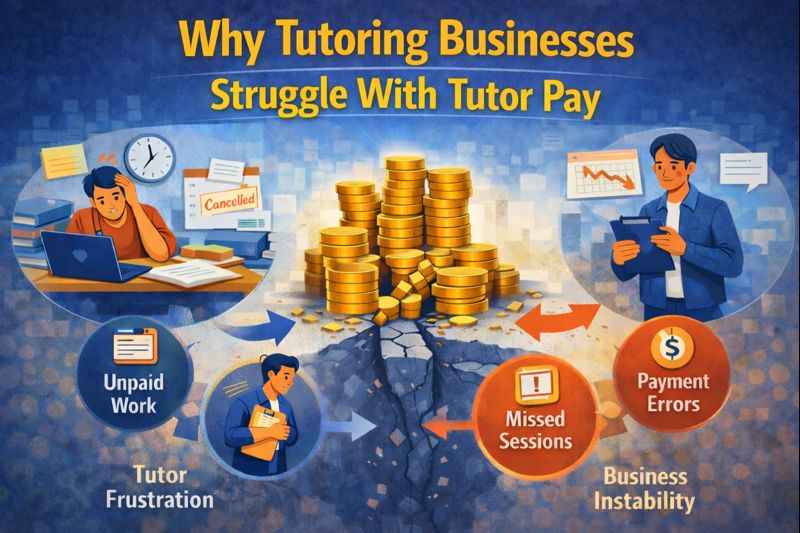
- Tutor pay problems rarely stem from hourly rates alone; they arise from how work, time, and responsibility are structured around those rates.
- When unpaid preparation, admin, cancellations, and emotional labour are considered, the effective earnings of tutors are often significantly lower than advertised.
- Structural gaps in pay models contribute to tutor dissatisfaction and operational instability for tutoring businesses, even when student demand remains strong.
- Treating tutor pay as a simple cost per hour ignores how tutoring actually functions in practice.
- Sustainable tutoring models depend on pay systems designed around structure, predictability, and operational clarity.
Introduction: Why Tutors and Tutoring Businesses face the same pay problem
For tutors, the frustration often sounds like this: “I love teaching, but the work just isn’t sustainable anymore.”
For tutoring business owners, it sounds like this: “We can’t seem to retain good tutors, no matter what we try.”
At first glance, these feel like separate problems. In reality, they are two sides of the same issue.
Tutors experience tutoring as a job that slowly demands more time, energy, and emotional labour without offering enough stability in return. Tutoring businesses experience constant churn, unpredictable delivery, and pressure from parents even when demand is strong.
In the middle of both experiences sits tutor pay. Not the hourly rate itself, but everything surrounding it.
This blog is written for:
- Tutors trying to understand why the work feels harder than it should.
- Tutoring businesses trying to build stable, reliable teams.
- And potential tutors or founders deciding what kind of tutoring model they want to be part of.
Because tutor pay is not just a financial decision. It is a structural one.
Why hourly pay became the standard model in Tutoring Businesses
Hourly pay models dominate tutoring largely for historical reasons. Traditional private tuition operated on informal agreements between students/parents and individual tutors, often paid per lesson. As tutoring businesses emerged and scaled, this model was carried forward.
Hourly pricing offers several apparent advantages. It is easy to explain to parents. It aligns neatly with session scheduling. It allows businesses to forecast revenue based on lesson volume.
However, convenience does not equate to suitability. Hourly rates assume that teaching effort begins and ends with the lesson itself. They implicitly frame tutoring as transactional rather than developmental. This assumption becomes increasingly inaccurate as tutoring businesses grow, introduce structured curricula, and take responsibility for learning outcomes.
The limitations of hourly pay become visible not immediately, but gradually, through tutor dissatisfaction, inconsistent delivery, and high turnover.
How hourly pay fails to reflect the actual work Tutors do
From the outside, tutoring appears simple: teach for an hour, get paid for an hour. But tutors know that the real experience is very different.
A single session often includes preparation beforehand, emotional energy during the lesson, and follow-up afterwards. Add in late arrivals, reschedules, parent messages, and progress tracking, and the “hourly” nature of the work quickly disappears.
For tutors, this creates a growing gap between effort and reward. For tutoring businesses, it often goes unnoticed, not out of neglect, but because these extra efforts rarely show up in reports.
Research in education reflects this pattern clearly. The Education Endowment Foundation identifies workload, particularly unpaid preparation and admin, as one of the main drivers of educator dissatisfaction and attrition.
The CIPD’s Good Work Index similarly shows that unpaid work strongly correlates with disengagement and turnover.
This explains why tutors can be paid fairly on paper but still feel undervalued in practice.
Psychologically, this aligns with Equity Theory, which shows that people judge fairness based on total input versus total return, not just salary.
When that balance feels off, commitment slowly fades.
Why unpaid work creates long-term dissatisfaction for Tutors
Perceived fairness in pay depends on total effort, not just salary. Equity Theory explains that individuals compare inputs such as time, energy, and responsibility with outputs such as pay, recognition, and stability. When this balance feels unequal, motivation declines over time.
In tutoring, imbalance often emerges gradually. Tutors take on additional responsibilities such as feedback, behaviour management, parent communication, and documentation without corresponding structural changes.
Even when hourly rates remain competitive, the role itself changes.
Without adjustments to workload design or pay systems, dissatisfaction becomes unavoidable.
The role of emotional labour in Tutor burnout and attrition
Tutoring is deeply personal work. Tutors support anxious students, rebuild confidence, manage exam pressure, and often act as emotional anchors, particularly in one-to-one settings.
This emotional labour is invisible, but it is significant.
The Education Support Partnership’s Teacher Wellbeing Index consistently reports high levels of stress and burnout among educators, driven by workload and lack of systemic support.
Burnout research by Christina Maslach shows that emotional exhaustion reduces engagement and empathy even among highly skilled professionals.
For tutors, this often shows up as quiet fatigue. For tutoring businesses, it appears as declining energy or sudden resignations.
Neither side intends for this to happen, but without supportive systems, it becomes inevitable.
How expanding Tutor responsibilities increases pressure on pay models
Modern tutoring extends beyond subject instruction. Tutors are now expected to follow learning frameworks, document progress, support student wellbeing, and contribute to measurable outcomes. Parents increasingly view tutoring as a structured educational service. While this professionalisation reflects industry growth, it places additional pressure on hourly pay models.
As responsibilities increase, a single teaching hour must account for planning, mentoring, tracking, and communication, tasks not captured within traditional pay structures. This mismatch affects tutors personally and tutoring businesses operationally.
Why Tutor pay issues directly impact business stability and growth
Tutor dissatisfaction rarely remains isolated. High turnover increases recruitment costs, disrupts student continuity, and weakens parent trust. Administrative workload expands as coordination becomes more complex. These issues can persist even when demand remains high, leading to growth without stability.
The underlying challenge is structural. Systems designed around hourly delivery struggle to scale alongside increasing complexity. Without redesign, businesses operate in continuous replacement cycles rather than building long-term teams.
What Tutor pay structures mean for new Tutors and new Tutoring Businesses
For individuals considering tutoring, long-term sustainability depends on predictable income, manageable workload, and reliable systems.
For new tutoring businesses, early decisions around pay often shape operations for years. Models that work initially may restrict growth later.
Understanding tutor pay as a system, rather than a rate, allows better long-term decisions for both tutors and tutoring business owners.
Where Wise Fits In
As tutoring businesses grow, tutor pay issues often emerge not because rates are unfair, but because the systems behind pay cannot keep up.
Hourly pay depends on accurate session tracking, clear attendance records, reliable scheduling, and consistent payment calculations. When these are managed across spreadsheets, messages, or disconnected tools, gaps appear. Sessions are missed, cancellations create confusion, and tutors lose clarity on what they are being paid for.
Wise helps solve this by connecting scheduling, session tracking, attendance, and payments in one platform. Every completed, cancelled, or rescheduled session is recorded automatically, creating a clear link between work delivered and pay processed.
For tutors, this means better visibility into sessions and more predictable payouts. For tutoring businesses, it reduces manual reconciliation and makes pay systems easier to manage as the business grows.
Wise does not decide how much tutors should be paid. Instead, it ensures that the pay structure a business chooses is executed accurately and consistently, without relying on manual tracking or fragmented tools. When the system is clear, pay becomes easier to trust.
Conclusion: Why Tutor pay must be designed as a system
Tutor pay is often discussed as a rate problem, but in practice, it is a systems problem.
Hourly rates were never designed to account for unpaid preparation, emotional labour, fluctuating schedules, or the expanding responsibilities that modern tutoring now demands. When these factors accumulate without structural support, dissatisfaction becomes unavoidable, even when pay appears competitive.
For tutors, this imbalance leads to quiet disengagement and eventual exit. For tutoring businesses, it results in churn, operational instability, and inconsistent learning delivery.
What connects both experiences is not motivation or commitment, but structure. Sustainable tutoring models are built when pay is treated not as a transactional cost per hour, but as part of a broader framework that includes workload clarity, predictable income, reliable processes, and operational visibility.
Businesses that recognise this early are better positioned to retain strong tutors, maintain continuity for students, and build long-term trust with parents. In an industry increasingly defined by professionalism, accountability, and outcomes, tutor pay can no longer sit in isolation. It must be designed as part of the system that supports the people delivering learning every day.
Because good tutors do not leave because they dislike teaching, they leave when the system around their work no longer works for them.
FAQs (Frequently Asked Questions)
1. Why do tutors leave even when hourly pay seems competitive?
Because the hourly rate rarely reflects the full scope of the work. When unpaid preparation, admin, cancellations, and emotional labour accumulate, the role often becomes unsustainable over time.
2. Does increasing tutor pay solve retention issues?
Not on its own. Without changes to structure, workload clarity, and payment reliability, higher rates often provide only short-term relief.
3. Why does unpaid work affect tutors so strongly?
Because it creates a growing gap between effort and reward. Over time, this imbalance reduces motivation, even when tutors enjoy teaching itself.
4. How does tutor turnover affect tutoring businesses?
High turnover disrupts student progress, weakens parent trust, increases recruitment costs, and adds ongoing operational pressure.
5. Is hourly pay the wrong model for tutoring?
Not necessarily, but it becomes fragile at scale. Without strong systems to track work, manage schedules, and ensure reliability, hourly models struggle to reflect real effort.
6. What do tutors value beyond pay rates?
Predictable income, clear expectations, fair workload, reliable payments, and trust in the systems supporting their work.
7. Why is tutor pay considered a structural issue rather than a financial one?
Because dissatisfaction usually arises from how work is organised and supported, not from the rate itself. Pay works effectively only when the surrounding systems function well.
8. What should new tutoring businesses think about early on?
Designing pay and operational systems that can scale, rather than relying on informal processes that become unstable as the business grows.