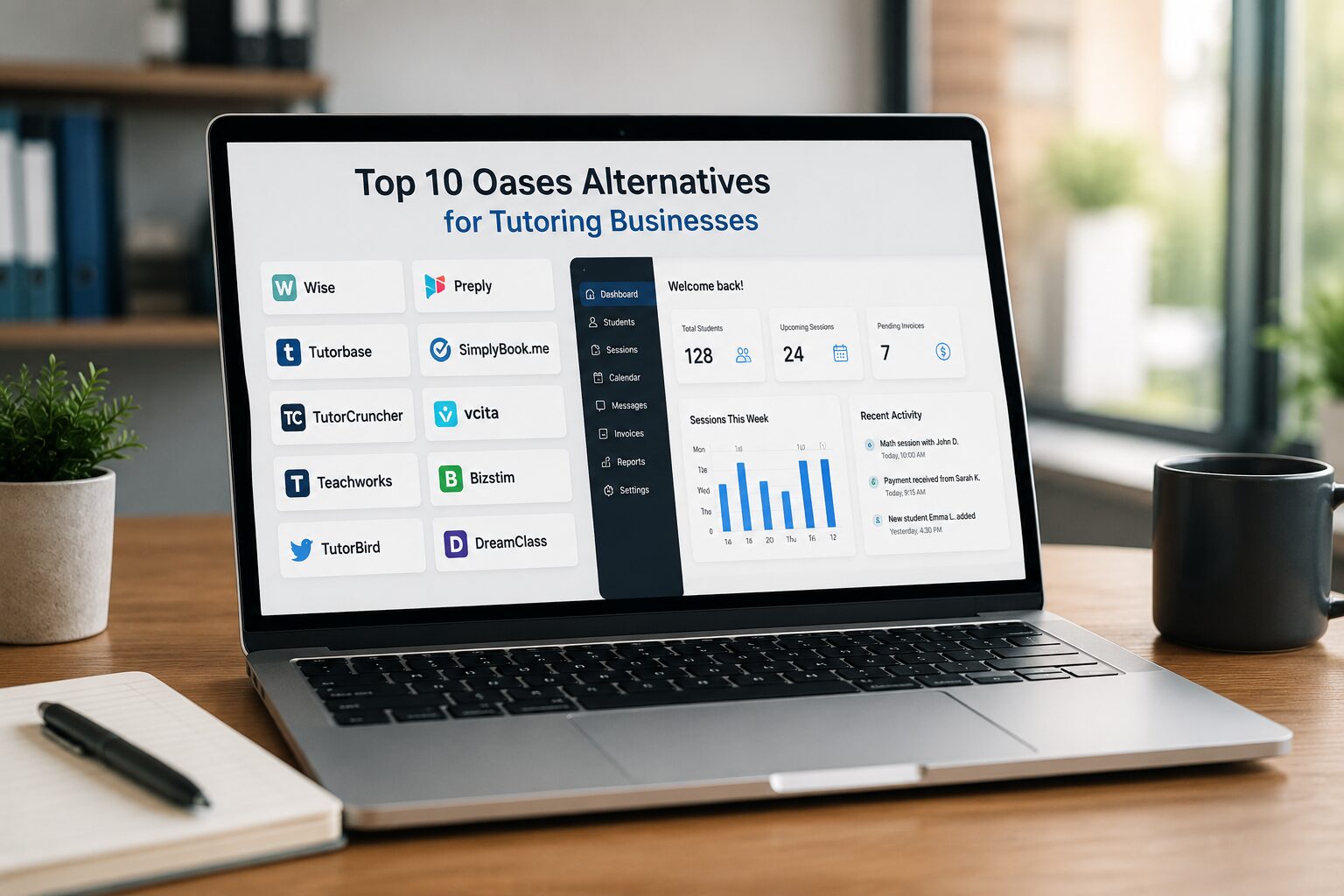

Acuity Scheduling books the appointment. A tutoring business needs the session tracked, billed, and reported too.
The best Acuity Scheduling alternatives for tutoring businesses are: 1. Wise, best for full tutoring management. 2. TutorCruncher, best for multi-tutor agencies. 3. TutorBird, best for solo tutors. 4. Teachworks, best for steady lesson volume. 5. Calendly, best for general team scheduling. The right fit depends on whether you need scheduling alone or full tutoring operations.
We checked each tool’s own pricing page and product site directly, not third-party listings, including how each one compares to tutor scheduling software built around the session, not just the calendar. Then we ranked each one by how far it goes past basic booking into attendance, billing, and parent contact, the gap that pushes most tutoring businesses off Acuity in the first place.
Key Takeaways
- Wise is the only tool here that closes the full loop: scheduling, attendance, billing, and a student portal in one place.
- Acuity Scheduling has no permanent free plan. Pricing starts at $16 a month billed annually, per Acuity’s own signup page.
- TutorCruncher serves more than 1,800 tutoring businesses across the UK, US, and beyond.
- Cal.com gives individuals a genuine free tier, while its Teams plan for Acuity Scheduling alternatives starts at $12 per user a month.
- Three tools here, TutorBird, TutorCruncher, and Teachworks, are built for tutoring but don’t connect billing to attendance the way Wise does.
1. Wise
Wise replaces Acuity’s calendar with a system built for the tutoring session. It syncs two-way calendars, tracks attendance, and bills each session automatically. Matt Coombs, Principal Product Manager at Paper.co, says Wise helped his team launch GROW by Paper, a tutoring program now running across school districts in North America.
This is the shift a tutoring business makes when it outgrows Acuity’s book-and-hope approach. BeGifted Tutoring in Thailand connected Wise’s API to its billing workflow. Business Director Kemjira Waritpariya reported an 80% jump in billing accuracy across high-volume operations.
See our full comparison of tutor scheduling software built for the classroom for more on how Wise stacks up day to day. Wise turns a booked slot into a tracked, billed, attended session. Acuity was never built to do that.
- Best for: Tutoring businesses that want scheduling, billing, and attendance in one platform
- Standout feature: Three-stage WhatsApp and email reminders at 24 hours, 1 hour, and 10 minutes before each session
- Pricing: Custom, based on tutor and student volume
2. TutorCruncher
TutorCruncher is an Acuity Scheduling alternative built for tutoring agencies. It manages a network of tutors, not just one calendar. It handles scheduling, tutor-student matching, payroll, and automated invoicing from one dashboard. More than 1,800 tutoring businesses across the UK, US, and beyond use it, according to TutorCruncher’s own site.
In a testimonial published on TutorCruncher’s own site, one agency owner reports running a tutoring business for 10 years before switching. That owner says the switch cut administrative workload by at least 60%.
TutorCruncher solves the agency-scale version of what Acuity can’t do. It matches the right tutor to the right student automatically.
- Best for: Tutoring agencies managing multiple tutors and client pipelines
- Standout feature: Intelligent tutor-student matching based on skills and location
- Pricing: Custom, based on business size
3. TutorBird
TutorBird is a simple alternative to Acuity Scheduling for solo tutors and small centers. It bundles scheduling, invoicing, and a student portal into one plan. That plan costs $16.95 a month for a single tutor, with every feature included. Each added tutor costs $4.95 a month more.
The tradeoff is mobility. TutorBird has no dedicated iOS or Android app. Tutors manage bookings through a mobile browser instead.
For a single-tutor business, TutorBird replaces Acuity’s calendar and adds billing. It does this without raising the price much at all.
- Best for: Solo tutors and small centers wanting one flat-rate plan
- Standout feature: Unlimited students and file storage at every tier
- Pricing: From $16.95/month for one tutor
4. Teachworks
Teachworks has run tutoring-specific scheduling and billing since 2014. It now serves language schools, music schools, and test prep centers. Pricing combines a $16.49 base fee with a per-lesson charge, so cost tracks lesson volume instead of staying flat.
That model rewards steady, lower-volume tutoring operations. It penalizes businesses with heavy seasonal spikes, since the per-lesson fee climbs with every session booked.
Teachworks ties billing to the calendar the way Acuity never does. The cost is a monthly bill that moves with your schedule.
- Best for: Education businesses with steady, predictable lesson counts
- Standout feature: Calendar-driven invoicing generated directly from scheduled lessons
- Pricing: From $16.49/month plus per-lesson fees
5. Cal.com
Cal.com is an open-source Acuity Scheduling alternative built for technical teams. It supports self-hosting and deep customization through a public API. The free tier covers one user with unlimited event types. The Teams plan runs $12 per user a month, billed annually, confirmed on Cal.com’s own pricing page.
A tutoring business without a developer on staff will find self-hosting adds real setup work. The hosted free and Teams plans are the practical entry point for most.
Cal.com gives a tutoring business scheduling infrastructure to build on. It is not a finished tutoring system on its own.
- Best for: Technical teams that want API access or self-hosting
- Standout feature: One-click import of existing Calendly events
- Pricing: Free for individuals, $12/user/month for Teams (annual)
6. SimplyBook.me
SimplyBook.me offers a genuine free plan for up to 50 bookings a month. Paid tiers then scale up to $59.90 a month for 2,000 bookings, according to SimplyBook.me‘s published rates. Its 77 optional custom features, including intake forms and HIPAA compliance, turn on only as needed.
For a growing tutoring center, the free plan runs out fast. The jump to a paid tier brings a wide service-industry toolkit that most tutoring operations won’t use.
SimplyBook.me is a general booking tool with many optional features. Few of them are built for a classroom.
- Best for: Small operations testing a booking tool before committing to a paid plan
- Standout feature: 77 optional custom features activated individually
- Pricing: Free up to 50 bookings/month; paid plans from roughly $10/month
7. Setmore
Setmore is a budget-friendly Acuity Scheduling alternative. Its free plan covers up to four users. Paid tiers start around $5 per user a month, billed annually. It integrates with Zoom, Stripe, and Google Calendar, so setup takes an afternoon.
Setmore has no built-in link between a booked session and a bill. A tutoring business still needs a second tool for invoicing and payroll.
Setmore handles the booking page well and stops there. Billing and student tracking go to something else.
- Best for: Very small teams that need scheduling only
- Standout feature: Free plan supports up to 4 staff members
- Pricing: Free for small teams; paid plans from about $5/user/month
8. Appointy
Appointy is built around distribution as much as scheduling. Clients can book directly through Facebook, Instagram, and Reserve with Google. Paid plans start at $19.99 a month, per Appointy‘s current rates, after a free tier for solo use.
A tutoring business built on parent referrals doesn’t get much from social discovery. Appointy’s strongest feature does the least work here.
Appointy solves a discovery problem most tutoring businesses don’t have.
- Best for: Businesses that get bookings through social channels
- Standout feature: Direct booking buttons on Facebook, Instagram, and Google
- Pricing: Free tier available; paid plans from $19.99/month
9. YouCanBookMe
YouCanBookMe focuses on a highly customizable booking page. A business can tailor notifications, confirmation pages, and booking questions to match its brand. A free plan and 14-day trial are available. Paid plans start at $9 a month for the Individual tier, or $8.10 a month billed annually.
The customization is real, but it stops at the booking page. It doesn’t extend to what happens after a session is booked and needs tracking or billing.
YouCanBookMe is a polished front door. No rooms are built behind it for attendance or billing.
- Best for: Businesses that want full control over the booking page’s look and questions
- Standout feature: Automated video links and CRM updates tied to each booking
- Pricing: Free plan available; paid from $9/month (Individual, monthly)
10. Calendly
Calendly is the most recognized name on this list. It’s built for team-based scheduling with deep integrations across Salesforce, HubSpot, and Zoom. The free plan is limited to one event type. The Standard plan unlocks unlimited event types for roughly $10 to $12 per seat a month, billed annually.
A tutor juggling recurring weekly sessions hits that one-event-type limit fast. And there’s still no attendance or billing layer once a session is booked.
Calendly integrates with almost everything except a tutoring business’s billing and attendance records.
- Best for: Teams that need broad third-party integrations
- Standout feature: Round-robin scheduling for distributing bookings across staff
- Pricing: Free (1 event type); Standard from $10/seat/month (annual)
Should You Switch From Acuity Scheduling?
The clearest signal isn’t price. Acuity has no permanent free plan and starts at $16 a month. Cost alone rarely pushes a tutoring business to switch. The real question is simpler. Should a booked session update attendance, trigger an invoice, and reach a parent’s inbox, all without a second tool doing the work?
If the answer is yes, the nine other tools above solve part of that problem well. They leave the rest to whatever spreadsheet or app fills the gap today. Compare Wise’s pricing against what you’re currently stitching together.
Try Wise Free Today
Book a demo to see how Wise connects scheduling, attendance, and billing in one system built for tutoring. Sign up free and run your first session without adding a second tool for invoices.
Frequently Asked Questions
What’s better than Acuity Scheduling for a tutoring business?
For general appointment booking, Calendly and Cal.com both improve on Acuity’s interface and integrations. For a tutoring business specifically, Wise fits better. It ties scheduling directly to attendance, invoicing, and a student portal, functions Acuity doesn’t offer. See our full comparison of tutor booking software for more options.
Which is better, Acuity or Calendly?
Calendly offers a genuine free plan and stronger third-party integrations, including Salesforce and HubSpot. Acuity includes more built-in payment and intake-form options at its paid tiers. Neither one tracks attendance or ties a session to a bill, so a tutoring business ends up patching the same gap either way.
What is the best free scheduler for tutors?
SimplyBook.me’s free plan covers up to 50 bookings a month. Setmore’s free plan supports up to four staff members. Both work for a very small tutoring operation. Once booking volume or student count grows past those limits, the free tier stops being free in practice.
Is Acuity no longer free?
Acuity Scheduling has never offered a permanent free plan. It gives new users a 7-day trial before requiring a paid plan starting at $16 a month billed annually, according to Acuity’s own signup page. That trial window is the same length it has been for several years.
What is the most used scheduling software for tutoring businesses?
Calendly has the broadest general-market adoption of any tool on this list, largely from sales and recruiting teams outside education. Among tools built specifically for tutoring, Wise and TutorCruncher show up most often in named case studies from agencies and multi-tutor operations. Usage figures for the tutoring vertical specifically aren’t publicly tracked by any single source.