
An online tutoring franchise charges a recurring royalty, which Indian franchise directories list between 5% and 30% of revenue. An independent agency pays no royalty but builds its own brand, tutor supply, and systems. Indian coaching and tax rules apply to both.
This guide compares the two models using government data, Indian regulation, and a worked royalty calculation. It also shows how an independent agency can run on Wise. You can see Wise pricing and book a demo to review the platform.
Online Tutoring Franchise: What the Market Data Shows
The National Statistics Office surveyed education spending in 2025. The Comprehensive Modular Survey on Education found that 27.0 percent of students were taking or had taken private coaching in the current academic year.
The share was 30.7 percent in urban areas and 25.5 percent in rural areas. Average annual household expenditure on private coaching per student was ₹3,988 in urban areas and ₹1,793 in rural areas. For higher secondary students, the national average was ₹6,384, with ₹9,950 in urban areas and ₹4,548 in rural areas.
How Franchise Directories List Tutoring Brands
Franchise India and Top Franchise publish investment and royalty figures for Indian education brands. The directories do not state their sources, and the figures are brand-reported rather than audited.
The listings show three royalty structures:
- A percentage of revenue, between 5 and 30 percent
- A fixed fee per subject per month
- A flat monthly minimum, which appears in some US franchise listings
Minimum investments in the listings range from about ₹10,000 to ₹30 lakh. The Top Franchise list of ten brands gives no franchise fee for any of them. Many entries do not state whether the programme is online, centre-based, or hybrid.
Best Online Tutoring Franchise: What Can Be Compared
No audited public ranking of Indian tutoring franchises exists, so a “best” list can only compare disclosed terms. These are the terms that differ between agreements:
- Delivery format: online, centre-based, or hybrid
- Territory: defined by city, PIN code, or student base
- Royalty base: revenue, per student, or per subject
- Minimum monthly royalty
- Term, renewal and transfer conditions
- Ownership of student and parent data
- Training, curriculum updates and marketing fund contributions
Online Tutoring Franchise Cost
Online tutoring franchise cost has four parts: the franchise fee, setup, working capital, and royalty. An independent agency has the last three, without the franchise fee or royalty.
| Cost line | Franchise | Independent agency |
|---|---|---|
| Entry fee | Paid to the franchisor | None |
| Technology | Set by the franchise agreement | Chosen by the owner |
| Marketing | Fund contribution plus local spend | Local spend |
| Royalty | Recurring, on revenue or per subject | None |
| Tutor payouts | Paid by the franchisee | Paid by the owner |
| Registration and tax | Paid by the franchisee | Paid by the owner |
What a Royalty Costs Over Time
The table below shows annual royalty for 80 students at three monthly fees. The fees are assumptions, not market quotes. Compare them with the survey averages above.
| Fee per student per month | Monthly revenue | Annual royalty at 10% | Annual royalty at 20% |
|---|---|---|---|
| ₹1,000 | ₹80,000 | ₹96,000 | ₹1,92,000 |
| ₹2,000 | ₹1,60,000 | ₹1,92,000 | ₹3,84,000 |
| ₹3,000 | ₹2,40,000 | ₹2,88,000 | ₹5,76,000 |
A per-subject structure scales differently. One listing shows ₹1,700 to ₹2,100 per subject per month. At that rate, 80 students taking one subject each would owe ₹1.36 lakh to ₹1.68 lakh every month, regardless of the student’s fee.
Over five years at constant enrolment, a 10 percent royalty on ₹3,000 fees totals ₹14.4 lakh. A 20 percent royalty totals ₹28.8 lakh. Royalty grows with enrolment and fee increases, because it is calculated on revenue.
Independent Online Tutoring Agency: Cost Lines
An independent agency carries no royalty, and takes on these functions directly:
- Tutor supply. Recruitment, vetting and onboarding.
- Quality control. Feedback standards and review.
- Pricing and packages. Fees, session bundles, and renewal terms.
- Parent reporting. Schedules, session records and progress updates.
Cost categories include business registration, tutor contracts, video and scheduling tools, payment collection, marketing, and working capital for tutor payouts.
| Factor | Franchise | Independent |
|---|---|---|
| Brand | Franchisor’s mark, licensed | Owner’s own |
| Recurring payment to a third party | Royalty for the term | None |
| Pricing, curriculum, tutor standards | Set by the agreement | Set by the owner |
| Exit | Governed by termination and transfer clauses | Owner decides |
| Coaching guidelines and GST | Apply | Apply |
| Statutory franchise protections | None specific to franchising | Not applicable |
Compliance Requirements in India
The Ministry of Education’s coaching centre guidelines define a coaching centre as one serving more than 50 students. The main conditions are:
- Students below 16 years cannot be enrolled
- Tutors must hold at least a graduate qualification
- Fees must be fair, receipts must be available, and fees cannot increase during a course
- Prospectus and study material cannot be charged for separately
- Students leaving mid-course receive a pro rata refund within 10 days
- Centres need one square metre per student, a fire and building safety certificate, first aid and separate toilets
- Penalties are ₹25,000 for a first offence and ₹1,00,000 for a second, followed by cancellation of registration
The GST Council’s education services flyer states that private coaching institutes are outside the exemption given to recognised institutions. Other education services are listed at the standard 18 percent rate. The flyer lists coaching under service code 999293 and does not state a registration threshold.
Legal Framework for Franchise Agreements
Legal commentary on franchising in India reports no specific franchise statute. Agreements are governed by the Indian Contract Act 1872, the Trade Marks Act 1999, the Competition Act 2002 and, for foreign franchisors, FEMA. The Competition Act prohibits anti-competitive agreements and abuse of a dominant position. Payments to an overseas franchisor must follow RBI norms. There is no mandatory pre-sale disclosure document, although commentary recommends one as good practice.
The same commentary states that in-term and post-term non-compete clauses can be enforceable if reasonable and not a complete restraint of trade.
How an Independent Agency Runs on Wise
Wise is tutor management software. Its knowledge base documents this workflow.
- Courses and tutors. Tutors are assigned to courses. The institute sets a payout rate per credit for each course, and rates can differ between courses.
- Session credits. Credits track the sessions a learner has paid for. They decrease when the tutor submits feedback and the sessions are consumed.
- Scheduling. Two-way Google Calendar sync matches availability. See tutor scheduling software.
- Reminders. The institute sets the schedule. Channels are email and app, and some institutes add text or WhatsApp. See automated session reminders.
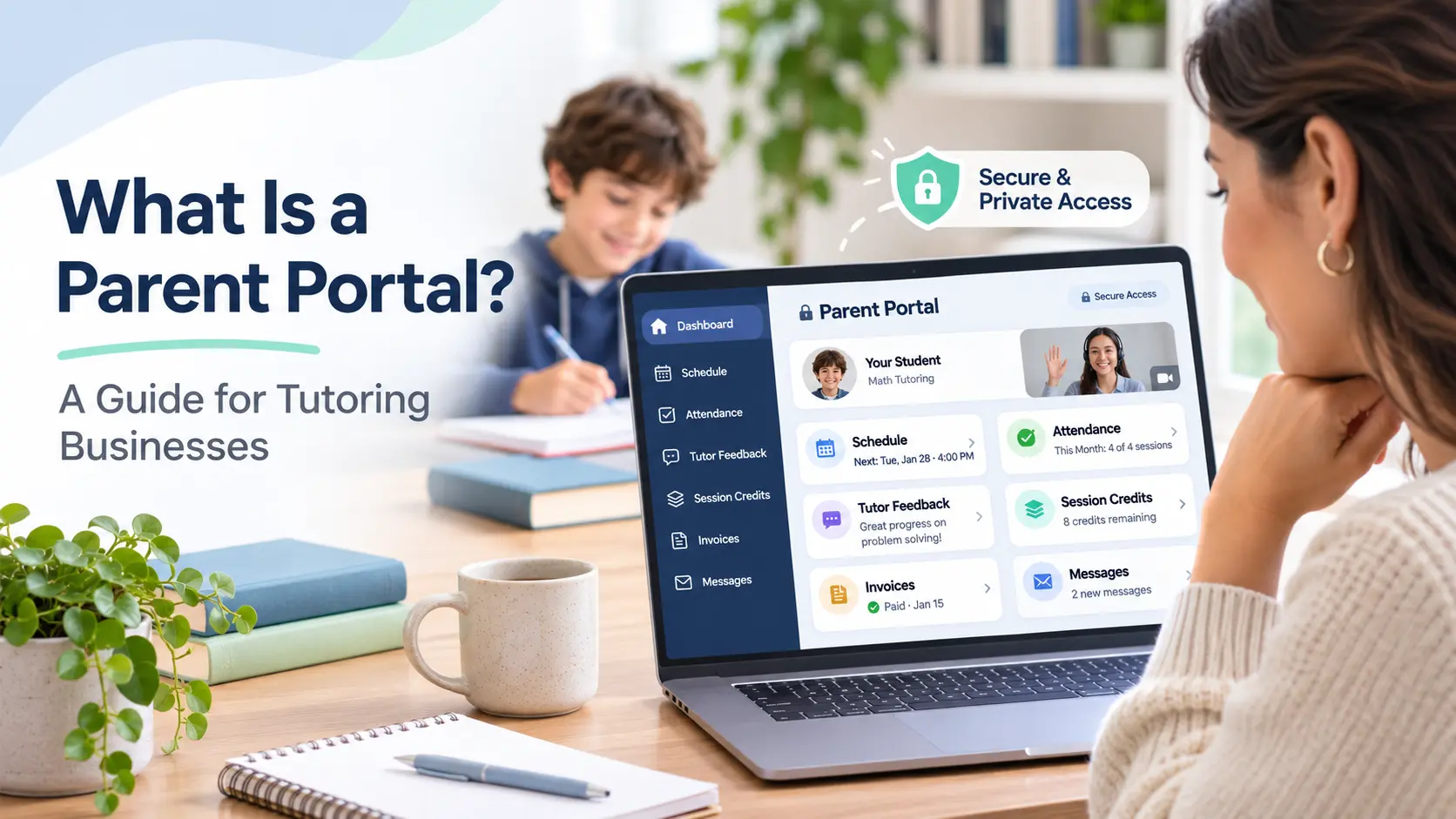
- Families. If the institute enables the notification, an automatic email goes to the student or parent after feedback, with the tutor’s Topics Covered and Comments. Wise also offers separate student and parent portals. Read what a parent portal includes.
- Reports. AI drafts progress reports from session summaries and feedback. An administrator reviews them before they reach a student or parent. The institute must enable this module.
- Recording storage. Under Account, Plans and Add-Ons, recordings can be set to delete automatically after a chosen number of days. Recordings in archived courses are deleted within 48 hours.
Wise covers scheduling, session records, credits, payouts, and family reporting. It does not provide a brand, curriculum, or student leads. The knowledge base does not state how one credit converts to session time, so confirm this with your account manager.
FAQs
Do online tutoring agencies fall under the coaching guidelines?
The guidelines refer to centres with premises, space per student, and fire safety certificates. They do not mention online coaching. The text does not clarify whether online-only providers are covered.
How many hours a day can coaching run?
Coaching should not exceed 5 hours a day. Classes for students attending school should not run during school hours. Weekly offs are required for both students and tutors.
How long does registration take?
The competent authority must decide within three months of receiving an application. Renewal applications are due two months before expiry. Appeals against refusal or cancellation must be filed within 30 days.
What do the guidelines say about advertising?
Centres cannot guarantee ranks or marks, and they cannot use misleading advertisements. A counselling system is also a condition for registration. A grievance committee is required.
Does each branch need a separate registration?
Yes, the guidelines require separate registration for each branch. They do not define a branch for online delivery. Existing centres had to apply within three months of the guidelines taking effect.
Related Reading
One-on-one tutoring software
Signs you have outgrown manual scheduling
Scaling tutoring operations
To see the workflow with your own courses, book a Wise demo.