

TL;DR
- Tutoring sessions often run over time, especially in online and subscription-based models.
- Most businesses either ignore overruns or handle them manually, which leads to revenue loss or admin overload.
- Manual billing for extra time does not scale and creates confusion for parents and staff.
- The cleanest way to handle extra time is to track actual session duration and bill based on usage.
- Modern tutoring softwares like Wise make this automatic, removing admin work and awkward conversations.
When tutoring sessions run longer than scheduled
Most tutoring businesses don’t plan for sessions to run over time. But more than 10% of their sessions often do.
A 60-minute lesson turns into 70. A student asks “one last question.” A group class needs extra explanation. Online sessions especially tend to spill over without anyone noticing until later.
When this happens, tutoring businesses usually fall into one of two problems:
- They don’t charge for the extra time, slowly losing revenue.
- Or they manually adjust invoices, creating confusion for parents and extra work for admins.
Neither approach works well at scale.
If your tutors run hundreds of sessions a month, even small overruns add up, both financially and operationally.
How tutoring businesses usually handle extra time
When tutoring sessions run longer than scheduled, most businesses rely on one of three approaches.
1) Ignoring the extra time
This is the most common option. Sessions are scheduled for 30 or 60 minutes. Tutors regularly go over. Nothing is tracked or billed differently.
At first, this feels harmless. But over time tutor hours don’t match revenue, margins quietly shrink, and no one knows how much extra tutoring is being delivered. Ignoring overruns works only when volume is low. As session count increases, the cost becomes invisible but significant.
2) Manually fixing invoices or tutor payouts
Some teams try to account for overruns after the fact.
They review session logs, add manual charges, and adjust invoices or tutor pay. This quickly creates problems. Admin effort increases, decisions become inconsistent, invoices confuse parents, and internal friction builds between operations and tutors.
Manual handling doesn’t scale. It just delays the pain.
3) Pricing sessions with built-in buffers
Another workaround is to price sessions higher and assume they’ll sometimes run long.
For example, selling 60-minute sessions but planning for 70, or charging more to average things out. This avoids admin work but introduces unfairness. Short sessions subsidise long ones, heavy users are undercharged, and light users are overcharged.
The problem still exists. It’s just hidden.
Why session overruns become a serious problem at scale for tutoring businesses
What feels manageable at 20 or 30 sessions a week becomes a real operational issue at scale for growing tutoring businesses. When hundreds of lessons run every month, even small overruns add up. Five extra minutes per session across 600 lessons results in 50 additional tutoring hours every month. That is a full-time tutor’s workload delivered without consistent billing or tracking.
This creates three compounding problems.
- Revenue leakage: Tutors are paid for time that is not billed or is billed inconsistently. Margins erode quietly, making growth harder over time.
- Billing inconsistency: Some parents are charged for extra time while others are not. Invoices become difficult to explain, which reduces trust even when teaching quality remains high.
- Operational stress: Operations teams spend time correcting sessions instead of improving systems. Tutors feel uncertain about when to end sessions or whether additional effort will be recognised.
At this stage, the issue is no longer about billing mechanics. It becomes a problem of control, predictability, and confidence in operational data.
Example: a San Diego test prep centre with session overruns
A test prep centre in San Diego runs 500 SAT and ACT tutoring sessions each month, all scheduled for 60 minutes. Tutors often go 5 to 10 minutes over to finish questions or explain mistakes properly. Individually, this feels harmless.
Across 500 sessions, an average overrun of 7 minutes adds up to nearly 60 extra tutoring hours every month. Tutors are paid for that time, but it is not consistently billed.
Calculation: 500 sessions × 7 extra minutes = 3,500 minutes, or ~58 unpaid tutoring hours per month. This is apprximately USD 10,000 dollars worth of lost revenue.
As the centre plans to scale, this small overrun turns into a real margin and operations problem.
How tutoring businesses can handle extra time with automated invoicing
The cleanest way to manage session overruns is to separate teaching time from billing complexity.
Instead of forcing tutors to end sessions abruptly or relying on manual adjustments later, modern tutoring businesses use time-based controls that work automatically in the background.
The most effective approach is a credit-based session system.
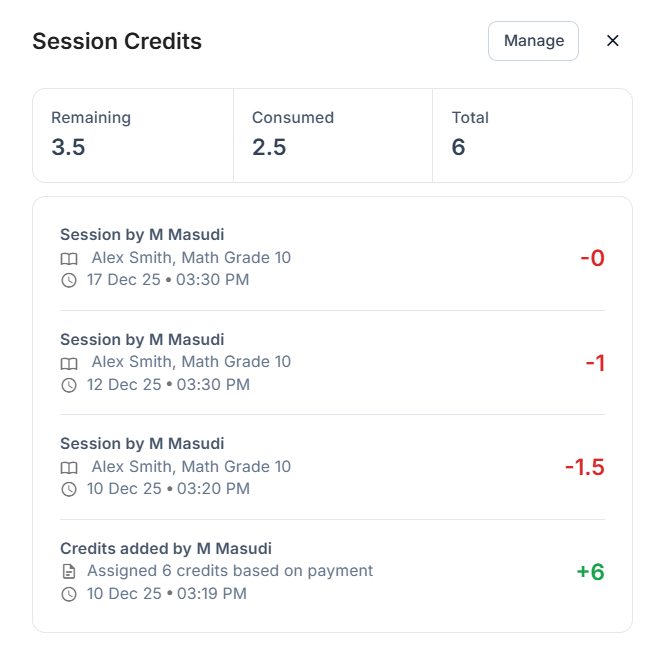
Each student or package is allocated a fixed number of hours or credits. When a session starts, credits are consumed in real time. If a session runs longer than planned, the system automatically records the additional time instead of ignoring it or requiring manual intervention.
This removes awkward conversations entirely. Tutors focus on teaching. Operations teams do not need to audit sessions. Parents see usage reflected clearly in their account.
There are three practical ways businesses apply this model.
- One approach is auto-deducting extra minutes from the remaining balance. A 60-minute session that runs for 90 minutes simply consumes 1.5 credits from the student’s available credits. (Assuming 1 credit = 60 minutes)
- Another approach is allowing sessions to go over and rolling the extra time into the next invoice. The overage is recorded automatically and charged at the same agreed rate, with no manual invoice edits.
- A third approach is setting controlled buffers. Sessions can include a small grace window, after which credits or overage rules apply. This protects tutors from rushing while still keeping billing accurate.
All three methods solve the same core problem. Extra teaching time is tracked, priced, and reconciled automatically.
How an advanced tutor management software handles session overruns in practice
An advanced tutoring software like Wise is designed to handle extra session time without changing how tutors teach or how parents are billed.
Every session runs on tracked time rather than assumptions. When a lesson starts, Wise records the actual duration automatically through the live session system. If a session ends on time, nothing changes. If it runs longer, the additional minutes are captured without any manual action.
For credit-based packages, the extra time is deducted directly from the student’s remaining balance in the form of proportional credits. There is no need for tutors to stop the session early or for admins to calculate adjustments later.
For subscription or monthly billing models, Wise records the overage against the account. The extra time appears as a clear usage entry and is reconciled automatically in the next billing cycle. And through a seamless payment gateway integration (Mollie, Stripe, etc) Wise auto-charges the payment method on file.
This ensures three things happen consistently.
- Tutor payouts reflect actual teaching time, not scheduled time.
- Parents see transparent usage instead of surprise charges.
- Operations teams maintain accurate revenue and cost data without manual reconciliation.
Wise also provides businesses with flexibility. Grace periods can be configured for short overruns. Credit consumption rules can differ between one-to-one and group sessions. Storage and recording retention settings can be adjusted so costs remain predictable.
The result is a system where sessions can run naturally while billing and payouts remain precise and fair.
Example: a UK maths tutoring business using Wise.live
A UK-based online maths tutoring business runs 700 GCSE and A-Level sessions each month.
Sessions often run a few minutes over. With Wise, actual session time is tracked automatically. Extra minutes are deducted from student credits or logged for monthly billing.
Tutors are paid accurately, parents see clear usage, and invoices no longer require manual fixes as the business scales.
When a credit-based session model makes the most sense
A credit-based session model is not about changing how tutoring is delivered. It is about choosing the right structure once scale and complexity increase. This model becomes especially important in three situations.
- When session volume is high: Once a business is running hundreds of lessons a month, even small timing differences compound. Credit-based tracking ensures every minute is accounted for without adding operational work.
- When tutors are encouraged to focus on outcomes rather than the clock: In many tutoring businesses, the best sessions do not end exactly on time. A credit-based system allows tutors to finish concepts properly while keeping billing accurate.
- When multiple billing models exist: Tutoring businesses that offer a mix of one-to-one sessions, group classes, subscriptions, and prepaid packages need a unified way to handle time. Credits provide a common layer that works across all formats.
This approach is valuable for online tutoring and in-person tutoring, where sessions can run over due to questions, technical delays, or engagement. It also helps hybrid businesses that run both in-person and online lessons maintain consistent billing logic.
At this stage, credit-based tracking is less about flexibility and more about operational reliability.
Conclusion: Stop losing time, revenue, and clarity as sessions scale
Session overruns are not a tutor problem. They are a systems problem.
As lesson volume increases, relying on manual fixes or informal rules creates hidden revenue loss, billing confusion, and operational stress. What starts as a five-minute overrun turns into dozens of unpaid teaching hours every month.
A credit-based session model removes this friction entirely. Extra time is tracked automatically, reconciled consistently, and reflected clearly for tutors, parents, and operations teams. Sessions can run naturally without awkward conversations or invoice corrections.
Platforms like Wise Tutoring software are built specifically for this reality. Actual session time is recorded, overages are handled automatically, and billing stays predictable even as volume grows.
For tutoring businesses expanding into online or hybrid delivery, solving session overruns early is not an optimisation. It is a requirement for sustainable growth.
Frequently asked questions (FAQs)
1. How do I charge for tutoring sessions that run longer?
Tutoring sessions that run longer can be charged by tracking the actual session time instead of the scheduled time. Extra minutes are deducted from the student’s remaining balance or added automatically to the next invoice. This removes the need for manual billing.
2. What does credit-based billing mean in tutoring software?
Credit-based billing means students buy a set number of hours or fixed numbers of sessions of defined duration. Each tutoring session uses credits based on how long it actually lasts. If a session runs longer, more credits are used automatically. For example 1 hour session would result in 1 credit being consumed and 90 minutes session would resut in 1.5 credit being consumed.
3. How do tutoring platforms track session time automatically?
Tutoring platforms track session time by connecting their tutoring software directly to live tools like Zoom. The system records when the session starts and ends and calculates the total duration without tutor or admin input.
4. How can tutoring businesses avoid editing invoices manually?
Tutoring businesses avoid manual invoice edits by using software that tracks session time and billing automatically. Any extra time is recorded and billed by the system, so invoices do not need to be changed after sessions.
5. Is credit-based billing better for online tutoring?
Credit-based billing works better for online tutoring because sessions often run longer than planned. Tracking time in minutes keeps billing fair, tutor payouts accurate, and margins predictable as lesson volume increases.