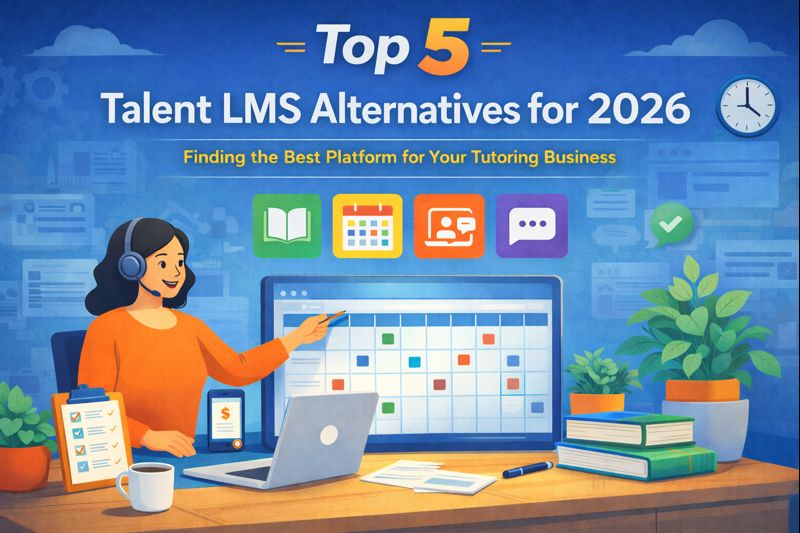
TL;DR
- Talent LMS works for training, but most tutoring businesses need tools built for live sessions, tutors, and operations.
- In 2026, tutors are choosing platforms that combine learning delivery, scheduling, payments, and engagement.
- As tutoring businesses grow, admin complexity increases faster than student numbers.
- Wise, TutorLMS, MeritHub, Moodle, and LearnDash each serve different tutoring models, from courses to live classrooms.
- The best alternative depends on whether you prioritize live tutoring, course monetization, customization, or business scalability.
Introduction:
Learning Management Systems were originally created for corporate training teams. Over time, many tutors and tutoring businesses adopted platforms like Talent LMS because they provided structure, learner tracking, and course management.
But tutoring in 2026 looks very different from corporate training.
Most tutoring businesses today are managing:
- Live 1-to-1 and group sessions
- Multiple tutors with different schedules
- Recurring students and parents who expect visibility
- Session-based pricing, packages, and subscriptions
- Growth without increasing admin workload
This is why many tutors now want more features that align with their operational reality.
In this guide, we’ll explore the top 5 Talent LMS alternatives for tutors and tutoring businesses in 2026, focusing on real-world tutoring needs rather than generic LMS features.
What Tutors actually need from an LMS in 2026
Before comparing tools, it’s worth resetting expectations.
Most tutors don’t wake up thinking: “I need a more advanced LMS.”
They think:
- “Scheduling is getting messy.”
- “I’m spending too much time on admin.”
- “Payments and sessions don’t sync well.”
- “Parents keep asking for updates.”
- “Scaling feels stressful and looks like a lot of work.”
So the real requirements are:
- Live tutoring support and not just an add-on
- Tutor and student management
- Scheduling, reminders, and attendance tracking
- Payments tied to sessions
- Clear visibility into progress and engagement
- Systems that scale without chaos
With that in mind, let’s look at the strongest Talent LMS alternatives for tutoring businesses.
1. Wise – The best talent LMS alternative for all Tutoring Businesses

Wise is not a traditional LMS.
It is a tutoring-first operating system built around how tutoring businesses actually function.
Where Talent LMS focuses on course completion and training paths, Wise focuses on sessions, tutors, students, and operations, all in one place. Wise is suitable for tutoring businesses, test-prep centres, and hybrid learning environments.
Why Wise is built for Tutors and not just learners:
Wise combines three things that tutors usually manage separately:
- Teaching & learning delivery
- Tutor and student coordination
- Business operations
This removes the need to juggle calendars, spreadsheets, payment tools, and communication platforms just to run day-to-day tutoring.
Key Ways Wise Solves Tutor Pain
- Live sessions are central, not secondary: Wise is designed around live tutoring. Scheduling, attendance, session history, and follow-ups are part of the core workflow.
- Automated scheduling and reminders: Tutor availability, student bookings, and reminders stay in sync, reducing no-shows and manual coordination.
- Tutor management at scale: Assign tutors, manage workloads, track sessions delivered, and maintain quality as your team grows.
- Payments and invoicing tied to sessions: Packages, subscriptions, and per-session billing are handled alongside teaching, not in a separate system.
- Student progress and engagement visibility: See attendance, session history, and engagement without asking tutors to manually report.
- Professional, branded experience
Parents and students see a structured, reliable system, not a patchwork of tools.
Wise vs Talent LMS:
Talent LMS answers the question: “How do I deliver and track courses?”
Wise answers the question: “How do I run and scale a tutoring business without drowning in admin?”
If your business relies on live teaching, multiple tutors, recurring students, and operational efficiency, Wise is the most complete Talent LMS alternative in 2026.
2. TutorLMS – Best for Course-Led Tutors Using WordPress

TutorLMS is a WordPress LMS plugin popular with educators who want flexibility, ownership, and control over their content. It is suited for tutors selling structured courses alongside tutoring.
Where TutorLMS works well for Tutors
TutorLMS is a strong option if your tutoring business includes:
- Self-paced courses
- Exam prep modules
- Recorded lessons that complement live sessions
Its strengths include:
- Easy course creation with lessons, quizzes, and assignments
- Monetization through one-time purchases or subscriptions
- Full control over branding and SEO
- Access to the broader WordPress plugin ecosystem
Where TutorLMS Starts to Struggle
TutorLMS is course-first, not session-first. As a result:
- Live session scheduling is external
- Tutor management is limited
- Payments are not inherently session-based
- Admin complexity grows as you scale
Compared to Talent LMS, TutorLMS gives more control and ownership. But compared to Wise, it lacks the operational backbone tutoring businesses need as they grow.
3. MeritHub – LMS with Strong Built-In Virtual Classroom

MeritHub combines traditional LMS features with an integrated virtual classroom. It is suited for group tutoring and highly interactive live classes.
Why some Tutors choose MeritHub
MeritHub shines when live interaction is the heart of your teaching model:
- Interactive whiteboards
- Live chat and collaboration tools
- Seamless movement between recorded content and live classes
For tutors running group sessions or cohort-based learning, this can feel very natural.
Limitations for Tutoring Businesses
While MeritHub is strong on teaching experience, it’s lighter on business operations:
- Payments and invoicing often require integrations
- Tutor management is basic
- Automation and admin reduction are limited
MeritHub improves on Talent LMS for live teaching, but it still doesn’t fully solve the business side of tutoring.
4. Moodle – Flexible Open-Source LMS

Moodle is one of the most widely used LMS platforms in the world.
Why Some Tutoring Institutions Use Moodle
- Highly customizable with plugins
- Strong assessment and grading tools
- Large global community and documentation
If your organisation has in-house developers or technical partners, Moodle can be shaped to fit many needs.
Why Moodle Can Be Heavy for Tutors
- Requires setup, hosting, and maintenance
- Live tutoring workflows are not native
- Scheduling, payments, and automation require add-ons
- Can feel complex for small to mid-sized teams
Compared to Talent LMS, Moodle offers more flexibility, but also more complexity. For many tutoring businesses, this slows growth rather than enabling it.
5. LearnDash – Structured LMS for Program-Based Tutoring

LearnDash is another WordPress LMS focused on structured learning journeys. It is suited for tutors running structured programs and learning paths.
Where LearnDash Fits Well
LearnDash works best for:
- Exam prep programs
- Step-by-step tutoring pathways
- Cohort-based learning models
It offers:
- Content dripping
- Quizzes and assignments
- Certificates and progress rules
Where LearnDash Falls Short for Live Tutoring
Like TutorLMS:
- Live sessions require external tools
- Tutor scheduling is not native
- Payments are disconnected from sessions
LearnDash improves on Talent LMS for structured programs, but still doesn’t replace a tutoring-specific platform.
How should Tutors choose the right LMS in 2026
For tutors and tutoring businesses, choosing an LMS is really about choosing what kind of day-to-day experience you want to run. If most of your value comes from live teaching, weekly sessions, recurring students, reschedules, and real interaction, then the platform you choose must be built around that reality.
Many tutors start with course-first LMS tools because they look comprehensive, only to realise later that live sessions feel bolted on, scheduling live elsewhere, and attendance or follow-ups require manual work. An LMS that doesn’t treat live tutoring as its foundation will eventually slow you down, no matter how polished its course features look.
The second thing to examine is where your time actually goes today. Most tutoring businesses don’t collapse because of poor teaching; they stall because of operational drag. Admin work creeps in quietly, managing calendars, coordinating tutors, chasing payments, updating parents, reconciling sessions, and switching between tools.
When evaluating a Talent LMS alternative, the key question is not “What features does this platform have?” but “How much work does this platform reduce?” The strongest platforms are the ones that replace multiple tools and reduce mental load, allowing tutors to spend more time teaching and less time managing systems.
Finally, the right LMS choice should make growth feel achievable rather than intimidating. Even if you’re a solo tutor today, your platform should still make sense when you have twice the students, more tutors, or more programs. Parents and students increasingly expect a professional, transparent experience with clear visibility into sessions and progress, and tutors need systems that don’t break under scale.
By the end of this decision, the right Talent LMS alternative should feel like it brings clarity instead of complexity, a platform that supports how you teach today and how you plan to grow tomorrow, without forcing you to rebuild everything later.
Frequently Asked Questions:
1) Is Talent LMS not good for tutoring businesses?
Talent LMS isn’t a bad platform; it’s simply built for a different use case. It works well for structured training and self-paced courses, but many tutoring businesses struggle once live sessions, recurring schedules, tutor coordination, and session-based payments become central. As tutoring operations grow, the gaps around scheduling, admin, and visibility become more noticeable.
2) What’s the biggest mistake tutors make when choosing an LMS?
The most common mistake is choosing an LMS based on features instead of workflows. Many tutors pick platforms that look powerful on paper but don’t reduce day-to-day admin. If live sessions, reschedules, tutor management, or payments still require external tools, the LMS may actually increase complexity rather than remove it.
3) How is Wise different from a traditional LMS?
Wise is built around live tutoring operations rather than course completion. It brings scheduling, tutor management, payments, session tracking, and learner engagement into one system. Instead of adapting an LMS to fit tutoring, Wise is designed specifically for how tutoring businesses operate day to day.
4) Can platforms like TutorLMS or LearnDash still work for tutors?
Yes, especially if your tutoring business is heavily course-based or built on WordPress. These platforms are strong for selling structured programs and self-paced content. However, most tutors still need additional tools for live session scheduling, tutor coordination, and payments, which can increase operational overhead as the business grows.
5) Will switching platforms be difficult for an existing tutoring business?
Switching always requires some effort, but many tutoring businesses find that staying on the wrong platform costs more time and money in the long run. The key is choosing a system that aligns with how you teach and plan to grow, so you’re not forced into another migration a year later.
6) How should a solo tutor think about choosing an LMS differently from a tutoring agency?
Solo tutors often prioritise simplicity and affordability, while agencies need scalability, tutor management, and automation. That said, many solo tutors choose platforms that already support growth so they don’t have to change systems once their student base expands. The right choice depends on whether you’re optimising for today or planning ahead.
7) What’s the clearest sign that a tutoring business has outgrown its current LMS?
When more time is spent managing schedules, chasing payments, updating parents, or reconciling sessions than actually teaching, the LMS is no longer supporting the business. Once admin work becomes the bottleneck to growth, it’s usually time to reassess the platform.